If your organization manages corporate or institutional art, you’ve likely faced the challenge of turning a static collection into an engaging exhibition that works across offices, campuses, or regions. The gap between owning artworks and presenting them with purpose can feel wide, but studying proven exhibition formats makes it far more manageable.
There are eight common types of art exhibitions, ranging from solo and duo shows (a duo exhibition features only two artists) to large-scale group, institutional, museum, retrospective, and online exhibitions. Each format serves a different curatorial goal, audience, and logistical reality. In this article, you’ll walk through specific, real-world art exhibition examples across these categories-and come away with a practical understanding of how to adapt them for your own collection, whether it’s spread across a single campus or multiple city offices.
Onward is built to support these exhibition formats by centralizing artworks, locations, loans, and virtual displays into one system. Let’s look at how the most effective exhibitions in contemporary art actually work.
Table of Contents
- Classic Solo Exhibition Examples in Contemporary Art
- Group Exhibition Examples: The Power of Curated Dialogues
- Museum and Institutional Exhibition Examples to Learn From
- Retrospectives and Long-Running Exhibitions: Looking Back with Structure
- Online Exhibition Examples and Hybrid Models
- Designing Your Own Art Exhibition: Applying These Examples with Onward
- Frequently Asked Questions
Classic Solo Exhibition Examples in Contemporary Art
A solo exhibition features only one artist’s work, and it remains one of the most significant milestones in an artist’s career. Solo shows generate buzz and exposure for artists, often showcasing recent works while sometimes spanning decades. They can occur in both gallery and institutional contexts, from a small commercial space in York to a national museum in Washington, dc.
Gerhard Richter: Panorama
One landmark solo show is “Gerhard Richter: Panorama” at Tate Modern in London (October 6, 2011 – January 8, 2012). This career-spanning exhibition traced roughly fifty years of paintings, from early black-and-white photo-based works to large, brightly colored abstract canvases. The show required sourcing works from collections across Europe and America, each of which needed detailed provenance documentation, condition reports, and loan agreements.
Carrie Mae Weems: Looking Forward, Looking Back
A more focused contemporary art solo example from American art is “Carrie Mae Weems: Looking Forward, Looking Back” at the Smithsonian American Art Museum (September 22, 2023 – July 7, 2024). The exhibit centered on themes of history and memory, blending video installation with photographs from the “Constructing History” series. The concept of the show, how a woman artist uses a lens to connect past and present, illustrates the power of a tightly curated solo format.
Historically, solo exhibitions have reshaped the art world. “When Attitudes Become Form” shifted how art was presented in 1969, and Marina Abramović’s “The Artist Is Present” was documented in a 736-hour performance at MoMA, demonstrating the form’s range from paper-based drawings to live performance.
How to Adapt the Solo Format
Corporate or campus collections can adopt this approach on a smaller scale. Consider a focused display of one contemporary artist’s photographs in a headquarters lobby, with works rotated every quarter. Visually, include a clean hero image of the flagship work, a short artist bio, exhibition dates, and a simple floorplan sketch. Onward helps here by maintaining a central record of all works in the solo show, tracking condition and location histories, and exporting wall labels directly from the database.
Group Exhibition Examples: The Power of Curated Dialogues
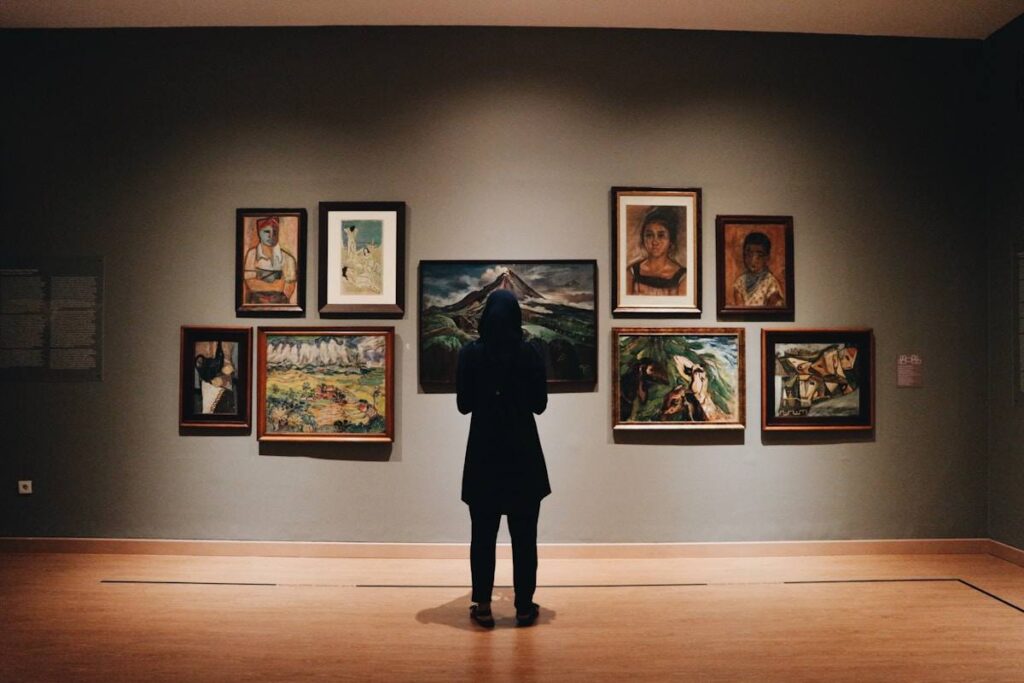
A group exhibition features at least three artists or more, organized around a shared theme or curatorial concept. Group exhibitions are often held in art galleries and museum spaces, and they allow galleries to showcase multiple artists simultaneously. Institutions use group exhibitions to support educational goals, and they can include new and emerging artists alongside established names. They’re also a natural fit for organizations looking to activate large or distributed collections.
Afrofuturism: A History of Black Futures
One of the most exciting recent examples is “Afrofuturism: A History of Black Futures” at the National Museum of African American History and Culture in Washington, dc (March 24, 2023 – August 18, 2024). This exhibition used over 100 objects across media, film, fashion, music, and comic books to explore how Black culture reimagines the future. The spatial structure included themed zones (“The History of Black Futures,” “New Black Futures,” “Infinite Possibilities”), with discovery treks letting visitors choose paths through the story. It’s a model for how a group show can blend art, culture, and community engagement through careful arrangement by theme rather than strict chronology.
Historical Precedents
Group exhibitions have shaped the art world since the early twentieth century. The Armory Show introduced European avant-garde styles to America, bringing work from Berlin, Vienna, Brussels, Madrid, and the Netherlands to New York audiences unfamiliar with modernism. Decades later, “Sensation” showcased Young British Artists and caused public controversy, demonstrating the power of curatorial provocation. “Manet and the Post-Impressionists” introduced “Post-Impressionism” to Britain in 1910, reshaping understanding of what contemporary art could mean. Art exhibitions at art fairs and festivals, such as the Venice Biennale, continue this tradition of curated dialogue.
How to Stage a Group Show in Corporate Settings
A university or corporate collection might stage a group exhibition across several floors or buildings, themed around an idea like “Urban Futures” or “Work and Wellbeing,” pulling drawings, paintings, and photographs from different departments. The key arrangement decisions include:
- By theme: grouping works that share a concept or subject
- By medium: separating paintings from photographs, fabric-based works, or digital pieces
- By chronology: tracing how artists across a generation respond to the same moment
Onward supports this with multi-location inventory views, rights, and loan management for external works, and checklists for installation and deinstallation, which are critical when coordinating across sites.
Museum and Institutional Exhibition Examples to Learn From
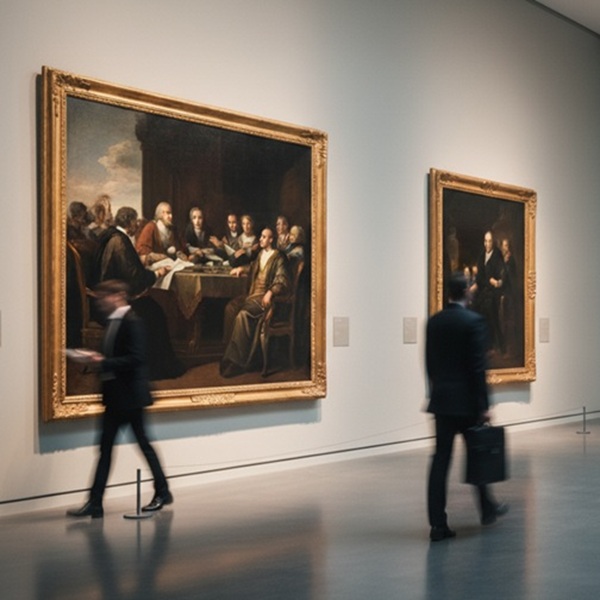
An institutional exhibition is defined by its venue-museum, foundation, art school, or auction house, and distinguished from commercial gallery shows by its educational and research focus. Institutional exhibitions occur in museums and art spaces of all sizes. They validate artists in the critical art world and are significant milestones in an artist’s career. These exhibitions can showcase permanent or loaned collections, and they include museums, auction houses, and art schools among their hosts.
Museum exhibitions often showcase permanent collections of art-the Louvre permanently displays Da Vinci’s Mona Lisa, for instance-but temporary exhibitions are also common in museums. Museum exhibitions can communicate socio-political messages and often pursue educational and academic objectives, making them useful models for any institution trying to represent its surroundings and values through art.
A Bold and Beautiful Vision
“A Bold and Beautiful Vision: A Century of Black Arts Education in Washington, DC, 1900–2000” at the Anacostia Community Museum (March 2024 – March 2025) is an institutional exhibit that uses approximately 85 archival photographs and artifacts across roughly 3,000 square feet. It’s arranged chronologically, from segregated schools through mid-century modernism, and includes interactive elements like a “Gratitude Garden” where visitors leave notes. The show grounds its meaning in local life and city history, making visible educators and students who shaped a community.
America’s Presidents: Lincoln by W.F.K. Travers
Within the National Portrait Gallery’s long-running “America’s Presidents” gallery, a nine-foot oil portrait of Abraham Lincoln by W.F.K. Travers (on view February 10, 2023 – December 31, 2027) serves as a semi-permanent anchor. The display includes tactile 3D prints of Lincoln’s face and hand for blind or low-vision visitors, plus audio descriptions-a cool example of how accessibility and interpretive depth can coexist. Portraits like this one represent the intersection of art and national memory.
Visual Formula for Institutional Shows
A practical art evaluation of what makes these exhibitions work reveals a consistent structure:
- Intro gallery: orienting text, key themes, connection to the institution’s mission
- Thematic rooms: works grouped by period, medium, or subject
- Interactive or digital area: touch elements, audio, or projection
Non-museum organizations, such as banks, hospitals, and law firms, can adopt this approach. Structure your in-house display around clear learning outcomes for staff and visitors, and use interpretive panels to give the collection meaning beyond decoration.
Retrospectives and Long-Running Exhibitions: Looking Back with Structure
A retrospective exhibition showcases an artist’s entire career, typically hosted by a major institution. They often occur later in an artist’s life and are considered significant honors in the art world because they canonize an artist’s work and importance. Major institutions host retrospective exhibitions for established artists, and recent years have seen major retrospectives in contemporary art across the globe, from Europe to America.
Century-Spanning Surveys
“A Bold and Beautiful Vision” functions as a retrospective of a community’s art education history, structuring a century of material (1900–2000) into digestible chapters. Each era is represented by key artifacts-photographs, tools, and student work-that let visitors explore how nature, sky, and moon imagery in student art evolved alongside social change. This chronological flow-early period, mid-century, late century-works equally well for a corporate “mini retrospective” of a key artist in your holdings.
Long-Running Anchors
Long-running displays like the Lincoln portrait within “America’s Presidents” (2023–2027) demonstrate how a single significant work can anchor a gallery for years, with rotating supporting material to keep the exhibit fresh. These require sustained management: years of insurance records, condition reports, and loan agreements must be unified and accessible. Art restoration considerations also arise as works remain on light-exposed display for extended periods.
Organizations can build internal retrospectives from their own archives, old commissions, past acquisitions, and exhibition documentation stored in secure cloud storage. Centralized systems like Onward simplify this by consolidating provenance, condition, and location data into a single searchable platform, so you can identify and find the right works without digging through paper files or disconnected spreadsheets.
Online Exhibition Examples and Hybrid Models
Online exhibitions are virtual art exhibitions existing only digitally, or extending a physical show into digital space. The first online exhibitions gained popularity around 2020, and the frequency of online exhibitions increased dramatically during the COVID-19 crisis. What began as a necessity has become a permanent fixture: art galleries now commonly have designated Viewing Rooms for online exhibitions, and these digital shows allow galleries to curate extra exhibitions and boost sales beyond their physical walls.
Hybrid in Practice
The Anacostia Community Museum’s “A Bold and Beautiful Vision” offers a strong hybrid model: virtual exhibit booklets, educator guides, and short films make the physical show accessible to anyone with an internet connection. Similarly, NMAAHC’s “Afrofuturism” provides digital toolkits, online stories, and discovery treks that deepen the visitor experience before or after a gallery visit. These approaches acknowledge that a single physical location can’t reach every audience.
Corporate and Campus Applications
Corporate and university collections can launch online exhibitions to connect satellite offices or campuses. Imagine a curated digital exhibition of American artworks across multiple locations, accessible through an internal portal. Each artwork includes high-resolution photo images, provenance notes, and navigation between themed rooms, giving remote employees the same connection to the collection as those who walk past the works daily.
Onward supports this directly: virtual exhibitions, image rights management, centralized media archives, and the ability to publish curated selections from the collection to an internal or external web front-end. The combination of physical and digital display isn’t just a trend-it’s the new baseline for making a collection matter.
Designing Your Own Art Exhibition: Applying These Examples with Onward
You’ve now seen solo, group exhibitions, institutional, retrospective, and online exhibitions-all grounded in specific contemporary art and American art examples. The question is how to translate these models into your own exhibition program.
Here’s a step-by-step framework:
- Define your theme: Identify a concept, time period, or medium that connects works in your collection. Use Onward’s artwork search and tagging to build thematic groupings.
- Select works: Apply clear selection criteria, condition, relevance, and availability. Use Onward’s Art Log for real-time location and condition data.
- Plan layout: Map works to physical or digital spaces. Decide whether to arrange by theme, chronology, or medium (as the examples above demonstrate).
- Prepare labels and didactics: Export wall labels, artist bios, and interpretive text directly from your database-no sign-off delays from manual formatting.
- Set up analytics: Track engagement, whether that’s visitor foot traffic for a physical exhibit or view counts for an online display.
- Manage loans and insurance: For borrowed pieces, Onward handles art loan tracking, insurance records, and due dates in one place.
Think beyond museums. Hospitals can adapt these exhibition examples to wellness programs, making art part of patient surroundings. Financial institutions can use themed group shows to support DEI initiatives. Universities can connect alumni engagement to retrospective displays of campus commissions, supported by virtual exhibitions for remote audiences.
The difference between a static collection and a living exhibition program comes down to structure, documentation, and the right platform.
Ready to turn your collection into an exhibition program? Request a demo of Onward and see how centralized collection management powers better exhibitions, from your first solo show to a multi-campus virtual display.
Frequently Asked Questions
What are the main types of art exhibitions?
The most common types include solo exhibitions (featuring one artist), duo exhibitions (two artists), group exhibitions (three or more artists), institutional exhibitions (held in museums or art institutions), museum exhibitions (showcasing permanent or temporary collections), retrospective exhibitions (highlighting an artist’s entire career), art event exhibitions (during fairs or festivals), and online exhibitions (virtual shows).
How can corporate collections benefit from solo exhibitions?
Solo exhibitions spotlight a single artist’s work, making it easier to tell a focused story and engage viewers deeply. For corporate collections, this format can highlight a particular artist’s vision or theme, create a dynamic lobby display, and refresh the collection regularly by rotating featured works. Onward’s platform helps manage these exhibitions by tracking artwork location, condition, and loan details.
What makes group exhibitions effective in institutional settings?
Group exhibitions enable institutions to curate artworks around shared themes or social issues, supporting educational and community engagement goals. They allow showcasing diverse artists simultaneously, including emerging talents. Organizing by theme, medium, or chronology helps create a coherent visitor experience. Onward supports multi-location management and loan tracking for such complex setups.
Why are retrospective exhibitions important?
Retrospectives provide a comprehensive overview of an artist’s career, often hosted by major institutions as a significant honor. They canonize the artist’s contribution to art history and can inspire renewed interest in their work. Corporations can create mini-retrospectives using archival pieces to celebrate artists represented in their collections, supported by Onward’s centralized data management.
How have online exhibitions changed the art world?
Online exhibitions expanded accessibility beyond physical venues, especially during the COVID-19 pandemic. They allow galleries and institutions to reach wider audiences, curate additional shows, and increase sales. Hybrid models combining physical and digital displays are becoming standard. Onward facilitates virtual exhibitions with secure image archives, rights management, and publishing tools for seamless online presentation.