Introduction: Office Art Ideas that Work Across a Modern Workplace
Most organizations treat office wall art as an afterthought – a task handed to whoever has a corporate credit card and a lunch break near a furniture store. The result is a collection of random prints that says nothing about your brand, does nothing for your people, and quietly fades in the sun. Research shows that art-filled spaces can increase productivity by up to 17%, and art in professional office environments directly influences employee mood and productivity. Art can convey a company’s values and culture – but only when it’s chosen with intention.
This guide extends our foundational post, Office Art Essentials: The Strategic Art of Selection and Placement, into concrete, room-by-room office art ideas for corporate and institutional settings. By the end, you’ll know what kinds of office artwork to select for every major workspace – from lobby to home office – and how to keep your collection trackable, insured, and aligned with your brand using tools like Onward.
Table of Contents
Introduction: Office Art Ideas that Work Across a Modern Workplace
Lobby & Reception: High-Impact Office Wall Art for First Impressions
Conference Rooms: Office Artwork that Supports Focused Collaboration
Open Plan & Workstations: Wall Art that Balances Energy and Concentration
Break Rooms, Cafés, and “Out of Office” Spaces: Art for Reducing Stress
Corridors, Stairwells, and High-Traffic Areas: Turning Pass-Throughs into Galleries
Executive Offices, Focus Rooms, and Quiet Zones: Highly Personalized Office Wall Decor
Home Offices and Hybrid Setups: Office Wall Art Ideas that Read Well On Camera
Planning, Rotation, and Governance: Keeping Office Artwork Fresh and Organized
FAQs: Practical Questions About Office Wall Art and Corporate Collections
Lobby & Reception: High-Impact Office Wall Art for First Impressions
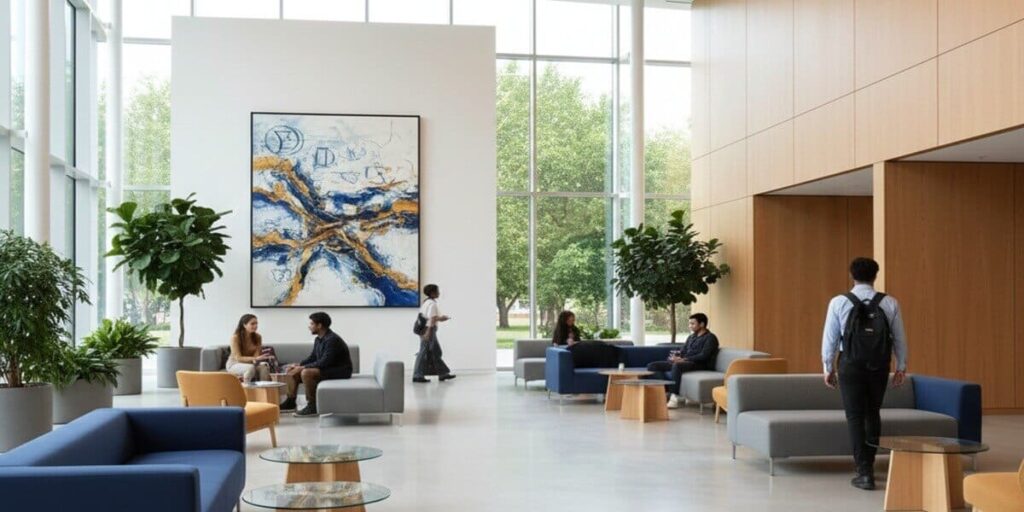
Your lobby is the most visible wall space in your entire organization. Visitors, recruits, and senior leadership form their first impressions within seconds. Art in reception areas should make a strong first impression, and placement of art affects that impression – bold pieces belong here, while calming art serves meeting rooms better.
Translate your brand values into lobby wall decor. A fintech firm might commission a large-scale abstract canvas inspired by data visualization; a healthcare system might choose calm nature photography that signals trust. Customized corporate art reinforces brand identity and makes strong impressions visitors carry into every subsequent conversation.
For sizing, artwork should cover 60 to 75% of wall space. On a 12-foot reception wall, that means a 72″ to 96″ wide canvas or triptych. Large art pieces create focal points in office spaces, anchoring attention the moment someone enters. Use UV-protected prints, durable framing, and non-glare glazing to keep sun-exposed lobby works pristine. Record each piece in an art inventory system like Onward with precise locations and installation dates – so your lobby focal point is documented, not just decorative.
Conference Rooms: Office Artwork that Supports Focused Collaboration
Conference rooms are where decisions happen. The art on the wall needs to support conversation without stealing it. Selecting art can depend on whether the goal is to calm, inspire, or energize – and each room type calls for a different answer.
Consider these pairings by room function:
- Client-facing boardrooms: Muted color scheme, sophisticated photography, or work by regional artists. Black-and-white photography offers a timeless and elegant look that works across industries.
- Internal project rooms: Bolder contemporary abstract works conveying motion and innovation.
- Small huddle rooms: One strong piece rather than several – larger art pieces reduce visual clutter compared to many small works.
Framed prints and posters are classic and versatile options for building thematic series across multiple conference rooms – different local neighborhoods, company milestones, or product lines that create subtle storytelling as people move between rooms. For placement, art above furniture should be 2/3 to 3/4 of its width, hung at standard museum eye level (~57″ center height). Log each work in Onward with room names and seating capacities so future refreshes correlate art choices with your corporate art style and employee feedback.
Open Plan & Workstations: Wall Art that Balances Energy and Concentration
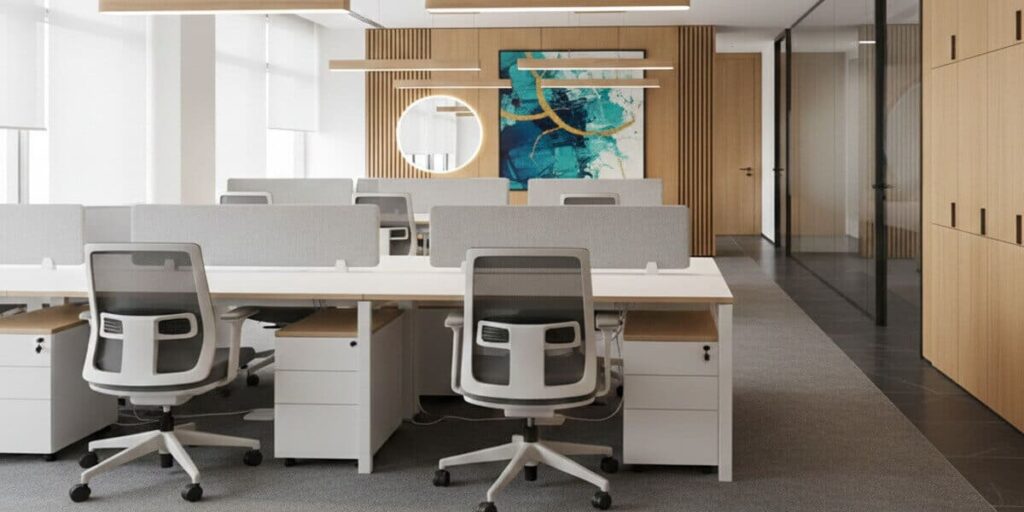
Open-plan areas house the majority of your workforce, and they demand careful art selection to maintain focus without turning the office space into a sterile box. Wall art can help reduce stress and increase focus – but only when it matches the zone’s purpose.
Biophilic design elements reduce stress and boost employee well-being, making nature scenes a strong default for dense workstation areas. Nature scenes in art can reduce stress and increase focus. Think soft forest photography, abstracted landscapes, or monochrome architectural photography in calm, mid-tone palettes. Color psychology suggests using blue for focus and productivity, so favor blue-green palettes near heads-down desk areas. Bright colors in art can enhance creativity, so reserve those for collaboration zones nearby – abstract art stimulates creativity and lateral thinking in exactly those settings.
For scale, use medium-sized works (roughly 24″ × 36″) repeated rhythmically every 8–10 feet along long walls, rather than one overpowering mural. Artwork can significantly improve productivity and creativity when it’s consistent and intentional rather than random. Tag pieces in Onward by zone – “focus,” “collaboration,” or “social” – so you can run collection analytics on which kinds get positive feedback or need rotation.
Break Rooms, Cafés, and “Out of Office” Spaces: Art for Reducing Stress
Break areas exist for psychological recovery. The art here should lower heart rates, not raise them. Nature-inspired art promotes a welcoming atmosphere and relaxation – soft seascapes, botanical prints, floral motifs, beach scenes, and cloudscapes all work. Nature scenes in art can reduce stress and increase focus, making these motifs ideal for spaces designed to pull people away from screens. Art can help break the monotony of the workday, which is precisely the function of a well-designed break room.
In employee-only lounges, allow more playful or staff-curated works. Rotating employee exhibits keeps the office feeling fresh, and involving employees in art selection can increase productivity by up to 37%. In guest-facing cafés, keep wall decor brand-forward but relaxing. For kitchen-adjacent areas, use washable surfaces, sealed frames, and moisture-resistant materials that handle humidity. Onward can manage rotating art via rotation schedules, condition reports after moves, and loan tracking when pieces are borrowed from your larger corporate collection.
Corridors, Stairwells, and High-Traffic Areas: Turning Pass-Throughs into Galleries
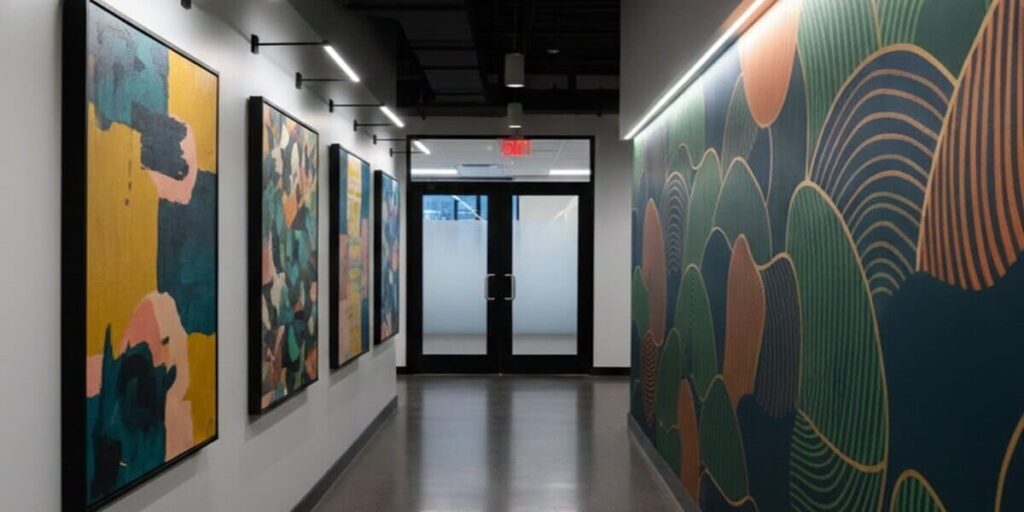
Corridors and stairwells are often your largest continuous stretches of office wall – and the most wasted. Use a series of smaller prints for long corridors to create a gallery effect: evenly spaced 18″ × 24″ or square 24″ × 24″ works telling a linear story. Consider a chronological company history, regional landscapes from locations where your business operates, or a curated series organized by medium.
Vertical works suit narrow stairwells; place a horizontal panoramic piece at stair landings to reward movement. Canvas art is durable and can last for a long time in high-traffic circulation areas, while metal and wood art pieces add texture and depth to spaces that might otherwise feel flat. Textile art adds texture and warmth to office environments, working well in rustic or vintage-styled corridors. Smaller pieces are ideal for filling corner spaces where a large work wouldn’t fit. Use durable frames and safe mounting systems meeting building code – an area we covered in detail in our Office Art Essentials post. Track each artwork in Onward’s locations hierarchy (building → floor → corridor section) to simplify audits during renovations.
Executive Offices, Focus Rooms, and Quiet Zones: Highly Personalized Office Wall Decor
Leadership offices and quiet zones carry symbolic weight. Art here can model organizational values and protect deep-focus time. Motivational art boosts morale and reinforces company culture when placed where it matters most – behind the desk of someone who sets the tone. Inspirational art can motivate and boost confidence for the executive and for everyone who visits.
For executive offices, pair one signature piece behind the desk – a commissioned portrait, a regionally significant landscape, or a conceptual work tied to mission – with smaller, intimate works on side walls. Large pieces create focal points in these rooms. Choosing art that represents you makes your office feel more personal; personalizing your workspace reflects your personality and interests. Geometric designs convey precision and innovation for leaders in technical industries, while a consistent color palette in art enhances branding across the suite.
For focus rooms and phone booths, keep it minimalist – monochrome line drawings, subtle geometric prints, or small-scale ocean photography with plenty of negative space. Choose art that reflects your personality and interests, but set parameters (themes, color scheme, size limits) so individual taste aligns with collection policy. Onward tracks which works are temporarily placed in named offices, including end dates and reassignment options when occupants change roles.
Home Offices and Hybrid Setups: Office Wall Art Ideas that Read Well On Camera
Hybrid work means your office wall art strategy now extends to employee home office setups, especially for video-heavy roles. A print that looks elegant in person can create distracting moiré patterns or harsh glare on camera.
For camera-friendly backgrounds, recommend mid-tone color schemes, a clear focal point behind the speaker (a single framed print, not a busy collage), and matte or non-reflective glazing. Suitable home office art ideas include subtle abstract prints, softly colored maps of key company regions, or licensed photography aligned with brand guidelines. Displaying local art fosters community pride and authenticity, even in a remote setting. DIY wall art projects can create unique personalized pieces for staff who want to participate. Wall decals and stickers are easy to apply and remove for employees who rent or move frequently.
Organizations with corporate art collections can extend selected works to senior remote staff via documented internal loans, tracked in Onward with loan start/end dates, shipping details, and insurance coverage. Provide an optional “art pack” for employees who want to align with brand visuals – guidelines and design inspiration, not mandates. Artwork can significantly improve productivity and creativity whether someone works in a campus or a spare bedroom.
Planning, Rotation, and Governance: Keeping Office Artwork Fresh and Organized
Once you know what art belongs in each space, you need a governance model to keep the collection coherent and well-documented. Create a simple art plan by zone: define objectives (reducing stress vs. signaling innovation), preferred media, and style parameters in a brief that facilities teams and curators can reference.
Suggested rotation cadences:
Space Type | Rotation Frequency |
|---|---|
Lobby & key conference rooms | Every 18–24 months |
Corridors & stairwells | Every 24–36 months |
Staff lounges & break rooms | Every 6–12 months (especially with rotating exhibitions) |
Provenance documentation, insurance values, and condition reporting matter across all these changes. Manual spreadsheets fail once you scale past a few dozen works. Organizations use Onward to manage centralized art inventory, location and condition monitoring, internal and external loan tracking, analytics on distribution by building or department, and secure image and document archives for every piece in the collection. A vision board of your complete collection – searchable, sortable, always current – replaces scattered files and guesswork.
FAQs: Practical Questions About Office Wall Art and Corporate Collections
These FAQs address common constraints for facilities managers, operations leaders, and in-house curators managing office artwork at scale.
What type of wall art is best for reducing stress in offices?
Nature photography with blue and green palettes, abstract works with soft edges, and ocean or beach imagery consistently perform well. Harvard’s Art Works at Work study found that quality, diversity, and mission-connection in art all shape employee emotional responses. These are ideal for break rooms, wellness rooms, and focus spaces. Explore pop and fun motifs sparingly – save them for social zones.
How many pieces of office wall art does a typical floor need?
A rough rule of thumb: one medium work per 8–10 linear feet of usable wall. It depends on your lighting, furniture density, color scheme, and clutter tolerance. A 10,000 sq ft floor might need 20–30 pieces across all zones. Use storage for seasonal rotation pieces.
How do we budget for office artwork without overcommitting?
Start with a pilot floor using a mix of original art and licensed prints. Track spend per square foot and correlate with feedback. 69% of employees in one major study agreed that attractive art boosts wellbeing and productivity – data that supports future budget requests. Onward’s inventory data helps justify forward spending with actual collection analytics.
How can we avoid office art looking random or dated?
Establish a simple art policy with cohesive themes by zone, a defined range of acceptable media, and a rotation schedule. Use Onward’s collection analytics to see what’s underused or ready for deaccession. An inspiring environment stays inspired when it’s actively managed, not set and forgotten.
What’s the best way to keep track of everything once we expand beyond a few dozen pieces?
Spreadsheets break down quickly – lost provenance, missed insurance renewals, no condition history. Dedicated art management software like Onward centralizes locations, provenance, insurance, shape and dimension data, and virtual exhibitions for remote stakeholders. It’s the difference between managing a collection and just having stuff on the walls, creating a system that makes every piece of art stay motivated by purpose.
Ready to manage your office artwork more systematically? Request a demo to see how Onward can help your surroundings work harder for your people.