In 2019, a six-figure acrylic commission cracked clean off a corporate lobby wall. The culprit was not the artwork itself but a set of basic plastic anchors rated for a fraction of the piece’s true weight. The replacement cost, litigation, and reputational damage dwarfed what a professional installation would have cost from the start. This guide exists so that scenario never happens to your organizaThis guide exists so that scenario never happens to your organization.
Table of Contents
What Is Professional Installation Art?
More Than Hanging a Picture: Viewer Engagement and Core Elements of the Practice
Types of Contemporary Art That Require Professional Installation
Why Professional Art Installation Matters for Sensory Experience
The Professional Art Installation Process
Choosing the Right Mounting and Support Systems
Art Placement Best Practices for Corporate and Institutional Spaces
Commercial and Corporate Art Installation
Residential Fine Art Installation and Private Collections
Common Art Installation Mistakes to Avoid
Wall Types, Weight, and Structural Considerations
Protecting Artwork During Transport and Installation
When to Hire Professional Art Installers-and How to Choose Them
Why Corporate and Institutional Clients Choose Onward
Art installation is the planned, technical, and conservation-minded process of placing artwork in offices, hospitals, museums, galleries, public spaces, and high-end residences. It applies to everything from framed works and sculpture to immersive installation art, where the piece may transform an entire room and demand structural, spatial, and environmental control. What started in the 1960s and 1970s as artists using whole spaces as the medium now also shapes how organizations must handle collection displays, temporary exhibitions, and complex multi-site installs.
Consider the scope: Christo’s Floating Piers installation spanned 3 kilometers on Lake Iseo in 2016. Yayoi Kusama’s Infinity Mirrored Room was first presented in 1965. Judy Chicago’s The Dinner Party features 39 place settings honoring women in art history. Each required meticulous professional installation to protect both the work and the people who experience it. If your organization manages corporate art, you’ve likely faced the same underlying challenge on a different scale: how to install works safely, document decisions, and preserve presentation quality across one site or many.
Improper execution introduces real risk: physical damage to irreplaceable works, safety hazards for staff and visitors, violated insurance and loan conditions, and long-term conservation failures from UV exposure, humidity, and vibration. That makes this essential reading for facilities directors, operations managers, curators, and business decision-makers responsible for corporate or institutional collections, including universities, healthcare systems, financial institutions, hospitality groups, and private collectors. At Onward, we are often brought in after something has gone wrong-untracked locations, missing documentation, ad hoc installers-and we use centralized data to prevent repeat problems.
You will find the fundamentals of professional art installation here: the types of artworks and projects involved, the technical process, commercial and residential requirements, common mistakes, wall and weight considerations, when to hire professionals, how to evaluate providers, and how Onward supports safe, well-documented installations at scale.tion.
What Is Professional Installation Art?
Professional art installation is a specialized service combining art handling, spatial planning, structural know-how, and conservation awareness. It applies to everything from framed photography to immersive installation art. While installation art is often site specific-designed for particular locations where site-specific installations create a unique relationship with their environment-the professional service of installing any artwork draws on the same disciplines. Removing a site-specific installation often diminishes its meaning, which is why documentation and precision matter so much from the start.
Installation art challenges traditional boundaries of viewing experiences, and it often involves viewer participation and interaction. Professional installers treat each artwork as part of a larger system: the physical space, sight lines, lighting, safety codes, and your organization’s brand. They work from detailed specifications-weight, dimensions, materials, hanging hardware, wall types, loan agreements, and insurance requirements-ideally stored in a centralized art inventory management system like Onward.
The practical range is broad. Installing a 3-meter Richard Serra maquette in a bank lobby is a fundamentally different project from rotating an exhibition of local installation artists in a university gallery space. Both require professional planning. Both require documentation: mounting methods, measurements, wall type, condition notes, and final placement attached to each object’s record for long-term reference.
More Than Hanging a Picture: Viewer Engagement and Core Elements of the Practice
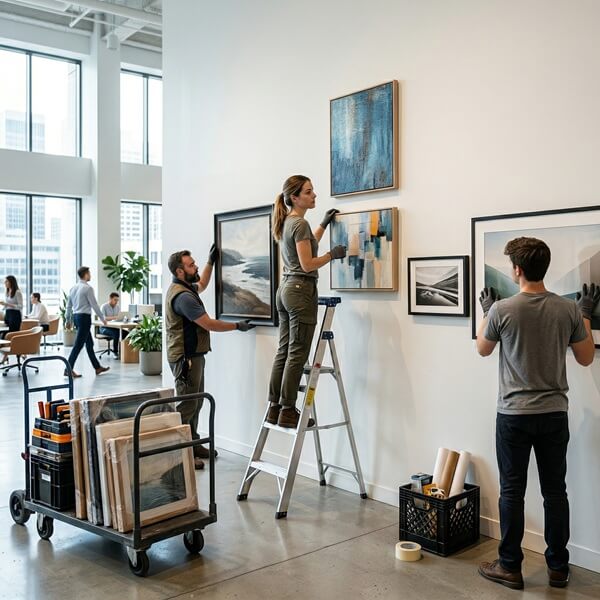
Professional installation consists of coordinated phases-planning, measurements, mounting systems, safety, and preservation-even for relatively modest art installations. Skipping any one introduces compounding risk.
Planning. Professionals review floor plans, HVAC layouts, fire code restrictions, and ADA requirements before deciding on placements. Installation art can be temporary or permanent, and planning must account for both scenarios. It utilizes various materials like light, sound, and found objects, and each material type demands different environmental controls. Onward’s location and condition monitoring supports this planning by showing where works currently sit and how long since their last move.
Measurements. Installers calculate viewing height-typically 145–155 cm to the centerline for standing viewers-consistent spacing between works in a series, and exact distances from architectural elements, using laser levels and templates. A 2 cm misalignment in a diptych is immediately visible.
Mounting systems. Anchors and hangers must match wall types, artwork weight, and security needs. Installation art can use mixed media and includes traditional art materials, meaning weight and fragility vary dramatically piece to piece. French cleats, gallery rails, and toggle bolts each serve different thresholds, and hardware should be rated for at least 2× to 4× the actual artwork weight.
Safety. Risk assessments cover heavy works, glass, suspended sculptures, and public-facing pieces, including child-safety concerns and egress routes. Installation art can use traditional and found materials, and found objects can have sharp edges or unstable structures requiring extra precaution.
Preservation. Walter De Maria’s New York Earth Room is a long-term site specific installation that simply filled an entire room with soil, where the only dimensional constants are the gallery’s walls. That work has been maintained since 1977 because of meticulous preservation protocols. Professional installers work with conservators to minimize handling, avoid microclimates, and track condition before and after installation using software like Onward.
Types of Contemporary Art That Require Professional Installation
Virtually any artwork benefits from professional installation, but certain types carry risks that make DIY unsuitable, especially for organizations managing valuable or public collections. Installation art often creates an immersive experience, and achieving it safely requires specialist expertise.
Paintings and framed photography: Large canvases over 20–25 pounds need appropriate anchors and professional hardware. Glazed frames add weight and fragility, while diptychs and triptychs require precise alignment.
Acrylic and glass artworks: These materials can crack under pressure, flexion, or uneven weight distribution. Proper standoffs and non-invasive mounting systems are essential, along with consideration of humidity and temperature changes.
Sculptures and mixed media: Freestanding works may require anchored plinths, seismic restraints, security cables, or custom supports. Pieces combining organic and industrial materials often need particularly careful handling.
Large-format and multi-panel works: Artworks spanning 10–20 feet or more may require structural assessments, lifting equipment, exact positioning, and coordination with lighting or audiovisual systems.
Mirrors and reflective installations: Heavy mirrors present shattering and injury risks and require robust anchoring. Mirror-based environments also demand careful planning around lighting, reflections, accessibility, and audience safety.
Temporary and immersive exhibitions: Interactive environments may involve lighting, sound, projection, water, or controlled visitor movement. Professional installers coordinate these elements to protect the artwork, the building, and the public while preserving the intended artistic experience.
Why Professional Art Installation Matters for Sensory Experience
Protecting valuable artwork. Incorrect anchors, over-tightened hardware, or poor handling can permanently damage a six-figure canvas or fragile conceptual art piece. Provenance documentation and condition reporting in Onward are undermined if the artwork is mishandled during the very process meant to showcase it. Installation art transforms spaces into immersive environments for viewers, but only if the works survive the installation intact.
Safety. When a heavy artwork falls in a busy corridor, the liability exposure is severe. Public safety, emergency egress, and local fire and building codes all shape professional installation decisions. Recent art installations address urgent issues like climate change and community, but none of those messages land if the work injures a passerby.
Better aesthetics. A misaligned series or poorly lit installation diminishes both employee morale and visitor perception of your brand. Olafur Eliasson incorporates natural elements like light and water in his work, and artist Olafur Eliasson’s The Weather Project was unveiled in 2003 at Tate Modern, drawing over two million visitors in part because the installation’s placement and lighting were flawless. Olafur Eliasson calls viewers “participants” in his installations-a philosophy that depends entirely on professional execution. Immersive installations can foster community and collective experiences, and recent installations prioritize themes such as sustainability and technology, but the viewer’s entire sensory experience starts with how carefully the work was installed. Installation art encourages viewers to rethink humanity’s relationship with nature, and that message is lost if the piece is crooked or falling.
The Professional Art Installation Process
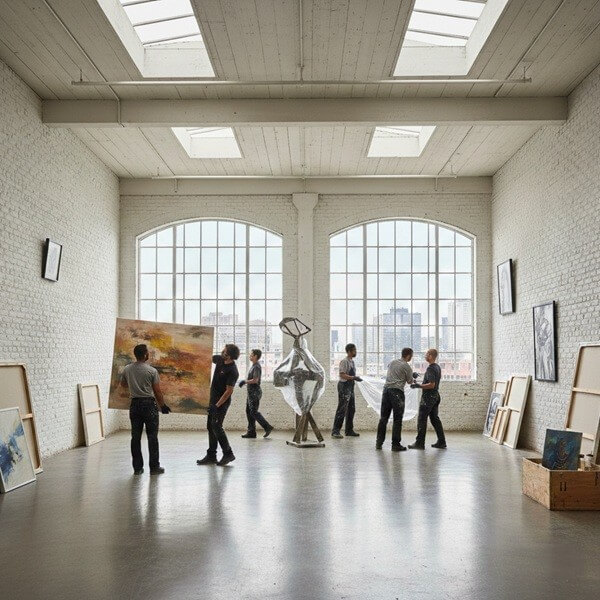
Here is a start-to-finish overview of a typical project workflow.
Initial consultation. Goals are defined-calming patient areas, showcasing local contemporary art, highlighting corporate values. Artwork lists are pulled from the collection database, and site constraints are identified. Notable examples of installation art explore human connection and digital life, and your goals may echo those themes. Recent installations highlight the blending of physical and virtual spaces, and your consultation should address whether digital or projection components are involved.
Space planning. Teams review floor plans and conduct walkthroughs to map high-traffic paths, quiet zones, and focal points: reception, elevator lobbies, conference rooms. Onward’s location tracking provides accurate current placements to plan rotations efficiently. Christo’s Floating Piers consisted of 3 kilometers of floating walkways-your hallway is simpler, but the same principle applies: plan the viewer’s journey.
Measuring and layout. The plan translates into wall-by-wall layouts, elevation drawings, and measurement diagrams. Each artwork is labeled with its inventory ID and planned coordinates. Spacing standards-typically 5–8 cm between frames in a series-are applied consistently.
Mounting selection. Installers specify hardware for each piece based on weight, substrate, security needs, and lender or artist requirements. Doris Salcedo’s installation Noviembre 6 y 7 commemorates a 2002 political event and required mounting solutions as sensitive as the subject matter. Every hardware choice is logged back into the artwork’s record.
On-site installation. The day-of process includes staging, unpacking, condition checks, safe handling, sequential hanging, AV testing for media works, and clean-up. In a 2025 children’s hospital wing installation, teams worked overnight to minimize disruption, with each artwork’s condition verified before and after placement.
Final inspection and documentation. Walk-throughs with stakeholders confirm leveling, labels, and sight lines. Onward is updated with photos, final locations, and installation notes for future audits and insurance verification.
Choosing the Right Mounting and Support Systems
The right mounting system is a structural decision, not an aesthetic afterthought. It is often the line between safe, long-term display and catastrophic failure. The term “installation art” became popular in the 1970s, and mounting technology has advanced considerably since. Allan Kaprow’s Yard in 1961 marked a new era for installations, and Marcel Duchamp’s Étant donnés was pivotal in installation art history-each pushed what spaces could hold and how.
Mounting Type | Best For | Typical Load |
|---|---|---|
D-rings and hooks | Light works in private offices | Up to 10–15 lbs |
Toggle bolts | Mid-weight on drywall without studs | 25–50 lbs |
French cleats | Heavy works, mirrors, corporate lobbies | |
Cable and gallery rails | Rotating displays, law firms, universities | Variable |
Security mounts | Hotels, retail, public campuses | Variable |
Floor anchors and rigging | Sculptures, suspended installation pieces | Engineered per piece |
For cable and gallery rail systems, Onward’s rotation planning helps you schedule frequent changes without losing track of what hardware is already in place. Security mounts and anti-theft hardware are critical in environments like hotel lobbies and retail spaces. For very heavy installation artworks-large metal works, dense stone traditional sculpture-structural engineering review is non-negotiable. Always document chosen mounting systems in your collection records for future reference.
Art Placement Best Practices for Corporate and Institutional Spaces
Where and how you place artwork affects wayfinding, staff wellbeing, patient comfort, and visitor impressions as much as the individual artworks themselves. Kara Walker’s silhouettes invite public exploration of racial history, demonstrating how placement and viewer engagement transform a hallway into a narrative journey.
Viewing height and sight lines. The standard baseline is approximately 57 inches (145 cm) from the floor to the center of the artwork for standing viewers. Seated areas-waiting rooms, hospital beds-shift this lower. Plan central sight lines from key approach paths: reception desks, corridor turns, elevator exits.
Spacing and grouping. Standards for grids, salon-style walls, and linear sequences vary, but consistency within a project is essential. Group works by theme, artist, medium, or color to tell coherent stories. Many installation artists working in series rely on precise spacing to build cumulative meaning, a principle that applies equally to your conference-area photography series.
Feature walls and large statement pieces. Anchor lobbies or atriums with large scale installations or signature works-a custom light installation inspired by The Weather Project, for instance. Various artists working with light treat the entire environment as their medium.
Lighting. Track lighting prevents hotspots and reflections. UV filtration protects sensitive works. Installation artists like James Turrell treat light as a core material, and even standard corporate installations benefit from that level of intentionality.
Interior design coordination. Collaborate with architects and designers so art placement supports your corporate art style, furniture layouts, and brand elements. Onward’s image archives help design teams preview options before install day.
Commercial and Corporate Art Installation
Commercial environments demand consistent quality across multiple sites, minimal downtime, and strong alignment with brand identity.
Corporate offices and headquarters. Installation strategies for reception areas, executive suites, boardrooms, and open-plan workspaces must account for security and confidentiality-avoid reflective works near screens displaying proprietary data. In interior spaces where employees spend the majority of their everyday life, thoughtful art placement can measurably improve satisfaction.
Hallways and circulation spaces. Use sequences or themed series to guide movement. Fire code clearance and accessibility rules (no protruding objects beyond specified depths) are non-negotiable. The viewer becomes the main actor in corridor installations, moving through a curated narrative.
Hospitality and restaurants. Hotel lobbies and dining areas need durable materials, anti-theft mounts, and works that perform well under fluctuating lighting and heavy foot traffic. A whole gallery approach to a boutique hotel hallway can transform the guest experience.
Healthcare facilities. Evidence-based design for patient comfort calls for calming color palettes and avoiding disturbing imagery. Special handling and infection-control rules influence where and how works are installed-art and life intersect most directly here.
Retail and public spaces. Temporary promotional installations, pop-up experiences, and social-media-friendly moments can draw on immersive environments inspired by Kusama’s infinity rooms or interactive “Obliteration Room” concepts. Interactive installations and performance art–style activations drive foot traffic and engage viewers in new forms of brand storytelling around the world.
Onward tracks which pieces are in which particular location, what hardware is used, and when rotations or maintenance are due across your entire portfolio of sites.
Residential Fine Art Installation and Private Collections
Residential installation differs from commercial work: more intimate spaces, irregular architecture, and closer collaboration with owners, designers, and sometimes the artists themselves.
High-value collections and family offices. Installing museum-quality works-including contemporary installation art or large-format photography-in townhouses, penthouses, and estates often falls under strict insurance and lender requirements. Proper art evaluation ensures coverage matches the collection’s true value.
Luxury homes and complex architecture. Double-height living rooms, staircase galleries, and integration with home automation (lighting scenes, motorized blinds for UV protection) create installation challenges that demand professional planning. Sight lines from multiple levels, fall risks, and engineering for heavy works on narrow or tall walls all require expertise.
Seasonal rotation and storage. Some collectors rotate works seasonally, requiring careful deinstallation, storage, and climate control. Onward’s condition logs, crate records, and storage-location tracking are critical for managing, say, a collection of 40 pieces across a New York apartment and a Palm Springs home. Each work carries its own history-its own provenance-and that data must travel with it.
Common Art Installation Mistakes to Avoid
These are preventable errors Onward encounters regularly when onboarding new clients with existing collections.
- Incorrect hanging height and poor alignment. Inconsistent heights and tilted frames undermine your professional image. A series hung at varying centerlines looks careless regardless of the art’s quality.
- Wrong anchors and ignoring wall material. A heavy mirror on basic plastic plugs in drywall is a liability. Understanding substrates-brick, concrete, steel studs, glass, tile-is non-negotiable.
- No climate or light consideration. Works near windows fade. Pieces in humid areas warp. Varnish cracks near HVAC vents. Environmental art and works made from unconventional materials are particularly vulnerable.
- Unsafe mounting and DIY shortcuts. Overreliance on single-point hanging, unsecured freestanding sculptures, or improvised hardware can violate lender or insurer requirements and endanger visitors.
- Lack of documentation. Failing to record installation methods, dates, and conditions means lost institutional knowledge. Onward solves this with structured fields and photo attachments tied to each artwork’s permanent record.
Wall Types, Weight, and Structural Considerations
The success of any installation depends on correctly matching artwork weight and hardware to the actual wall or ceiling structure-which often differs from architectural drawings.
Common wall types:
- Drywall (wood or steel studs): Most common; simple nails support 5–10 lbs, toggles 25–50+ lbs
- Concrete and brick: Require masonry anchors and hammer drills; excellent load capacity once properly anchored
- Wood paneling: Generally strong but may split; pilot holes recommended
- Glass partitions: Rarely suitable for direct mounting; use adjacent structures or freestanding solutions
- Tile: Drilling risks cracking; specialty bits and adhesive systems are standard
Weight calculations. Always weigh the complete assembly-frame, glazing, hardware. A painting labeled “30 lbs” may reach 40+ lbs once framed and glazed. Apply safety factors of 2× to 4× when selecting hardware. For very large metal works or dense stone sculpture, consult a structural engineer.
Seismic and regional factors. Earthquake-prone regions require restraints, anti-tip devices, and sometimes custom conservation-grade mounts. The Met employs conservation preparators who craft earthquake-safe mounts that are nearly invisible to visitors. Store wall-type notes, weight data, and mounting specifications within your collection records in Onward so future re-hangs can reference accurate, historical installation information.
Protecting Artwork During Transport and Installation
Many losses occur not on the wall but in transit and handling-from storage to truck to site to final placement.
Packing and transportation. Use soft wrapping, corner protectors, travel frames, and climate-controlled vehicles. Label every crate and package with object IDs that link to records in Onward. Art restoration becomes necessary when handling shortcuts cause preventable damage.
On-site handling. Gloves, clean surfaces, and staging areas away from active construction are baseline requirements. Moving oversized works through elevators and stairwells demands planning to avoid scraping or flexing. Traditional art forms on canvas and panel are particularly vulnerable to flex damage.
Condition checks. Conduct condition reporting immediately before and after installation. Annotated photos uploaded to your art management software satisfy lenders and insurers and flag early signs of damage. This is where the human experience of stewarding a collection becomes concrete: you are building an auditable record that protects your organization for decades.
When to Hire Professional Art Installers-and How to Choose Them
Professional installers are strongly recommended when you are working with high-value or irreplaceable works, heavy or large-format pieces, public or high-traffic areas, and complex installation artwork involving sound, light, or interactive components. A space played electronic sounds from tape machines spread throughout a 1960s gallery-today, that same complexity appears in corporate AV installations that layer spoken words, ambient music, and projection. A broad range of technical skill is required.
Insurance and loan requirements. Lenders, museums, and insurers often specify professional installation, approved hardware, and documentation. Failing to comply can void coverage. An earlier version of your insurance policy may have been less strict, but modern art market standards have tightened considerably.
Choosing a provider. Evaluate candidates on:
- Experience with your project type (corporate, healthcare, hospitality, modern art collections)
- Portfolio of completed projects and references
- Proof of insurance and safety certifications
- Clarity of scope, timeline, and pricing
- Ability to coordinate with facilities, security, IT/AV, and design teams
- Comfort integrating with your collection management platform-reading object lists from Onward, updating install status in real time
Ask prospective vendors: “Can you walk me through the last corporate collection installation you completed, from consultation through final documentation?” Their answer will tell you everything about their process maturity.
Why Corporate and Institutional Clients Choose Onward
Better data makes planning, executing, and auditing installations far more reliable. Onward is the software backbone that connects every phase described in this guide.
Museum-quality standards at enterprise scale. Onward lets you attach detailed installation instructions, hardware specs, lender requirements, and conservation notes to each artwork record. This ensures consistency across sites and vendors-whether you manage ten offices or a hundred.
Art inventory and loan tracking. Generate install-ready checklists for internal teams or external installers, including object locations, crate IDs, and loan conditions for pieces borrowed from art world institutions or famous installation artists’ studios. Many installation artists working with sensory stuff-light, sound, projection-require specific environmental parameters that must be tracked.
Location, condition, and analytics: Track artworks across buildings, document their condition before and after installation, and report how the collection supports brand, employee, client, or patient experience. While perceptions of art are subjective, objective data on placement, condition, and rotation improves decision-making.
Rotating and virtual exhibitions: Plan rotations, record temporary installations, and preserve digital documentation after an exhibition ends. Applying “total installation” thinking—where the entire environment contributes to the work—can also strengthen a corporate collection strategy.
Facilities, legal, curatorial, and executive teams need a single source of truth. Employees and visitors deserve spaces that feel intentional and well cared for. Professional installation, supported by accurate collection data, helps organizations deliver a consistent and meaningful experience.
Ready to bring museum-level rigor to your art installations? Request a demo of Onward and see how centralized collection management transforms every installation from guesswork into a repeatable, documented process.