
Art provenance is more than background information. It is a practical record of where an artwork has been, who has owned it, and what documentation supports its history. For collectors, institutions, and organizations managing valuable collections, strong provenance helps protect value, reduce ownership risk, and support better decisions across acquisitions, loans, insurance, and reporting.
For corporate collections, universities, financial institutions, galleries, and distributed collections, provenance is also an operational issue. Records are often spread across offices, file folders, storage rooms, spreadsheets, and email threads. When documentation is hard to find or incomplete, even routine collection management becomes more difficult. That is why many organizations are moving toward centralized systems that connect artwork records, document storage, inventory management, and location tracking in one place.
In This Guide
- Understanding Art Provenance and Its Role in Collection Management
- Why Provenance Matters for Value, Legitimacy, and Risk Reduction
- The Core Elements of a Strong Provenance Record
- Common Challenges and Gaps in Provenance Documentation
- Methods for Researching and Verifying Art Provenance
- The Relationship Between Provenance, Insurance, and Collection Risk
- How Technology Improves Provenance Tracking and Documentation
- How Onward Supports Provenance Management Across Collections
Understanding Art Provenance and Its Role in Collection Management
Art provenance refers to the documented history of an artwork’s ownership, custody, and movement over time. It may include previous owners, purchase dates, gallery or auction records, exhibition history, publication references, condition reports, and supporting documents that help establish the work’s background.
It is important to distinguish provenance from related concepts. Provenance is not the same as authentication, although the two often support each other. Authentication focuses on whether a work is genuinely by a particular artist or from a particular period. Provenance focuses on the documented chain of history around that work. Provenance is also broader than a simple ownership record. A single invoice may prove one transfer, but provenance usually brings together multiple sources that create a fuller and more credible history.
In the art market, provenance has long influenced trust. Buyers, curators, appraisers, insurers, and lenders look for documentation that explains where a work came from and how it has been handled. The stronger and more complete the record, the easier it is to evaluate legitimacy and reduce uncertainty.
In day-to-day collection management, art provenance plays a practical role. It helps teams organize documents, maintain consistent records, support internal reporting, and prepare for transactions or audits. For an organization managing works across multiple offices or storage sites, provenance becomes part of the operational record for each object.
A painting in a bank headquarters, for example, may have a purchase invoice in one office, a condition report in another, and exhibition history stored in an old email archive. Without a clear system, teams lose time piecing together basic information. With organized provenance linked to each artwork record, the collection becomes easier to manage, report on, and protect.
Why Provenance Matters for Value, Legitimacy, and Risk Reduction
Provenance affects far more than historical interest. It can directly influence an artwork’s value, legitimacy, and risk profile. When a work has a clear and well-supported history, buyers and stakeholders tend to have greater confidence in it. That confidence can make acquisitions smoother, support appraisals, and strengthen marketability in future sales or loans.
Art provenance also helps reduce exposure to serious risks. Incomplete documentation can raise concerns about forgery, theft, unlawful transfer, or disputed ownership. Even when no actual problem exists, uncertainty can slow decisions and increase due diligence costs. For organizations managing high-value collections, that uncertainty becomes an operational burden as well as a financial one.
Insurers, appraisers, and lenders also rely on provenance. An insurer may want evidence of lawful ownership and supporting documentation before underwriting a high-value work. An appraiser may use provenance alongside condition, artist history, and comparable sales to form a valuation. A lender considering art-backed financing may view complete records as part of the asset’s credibility and risk assessment.
Provenance matters during transactions because it helps answer practical questions. Was the work acquired through a reputable source? Has it appeared in exhibitions or publications? Are there records that support ownership over time? Is the current documentation sufficient for a loan, sale, donation, or claim?

Consider a university collection preparing works for an exhibition loan. If the team can quickly access invoices, prior loan history, condition reports, and related provenance documents, the process is more efficient and less risky. If those records are scattered or missing, the institution may face delays, additional research, or concerns from borrowing partners.
For that reason, provenance is not just an art history topic. It is a core part of collection governance, risk reduction, and informed decision-making.
The Core Elements of a Strong Provenance Record
A strong provenance record brings together the documents and facts that explain an artwork’s history in a clear, organized way. While the exact file may vary by artwork and collection type, certain elements appear again and again in effective provenance documentation.
Ownership history is usually the foundation. This includes previous owners, dates of transfer when known, and the source through which the work changed hands. Bills of sale, invoices, purchase agreements, and donor records help support that chain. Exhibition history adds another layer by showing where the work has appeared publicly, while publication history can help confirm that the work has been documented in catalogs, books, or articles.
Condition reports and conservation or restoration records are also valuable. These help establish how the work has been handled over time and may support both risk management and claims review. Certificates, correspondence, customs paperwork, shipping records, and related documents can further strengthen the record, especially for works that moved across regions or institutions.
Below is a practical overview of common provenance documents and why they matter.
| Provenance Document | Purpose |
| Bill of sale or invoice | Confirms a transaction and helps establish ownership transfer |
| Purchase agreement | Documents acquisition terms and source details |
| Ownership history record | Summarizes known chain of custody over time |
| Exhibition record | Shows where and when the artwork was publicly displayed |
| Publication reference | Links the artwork to catalogs, articles, or books |
| Condition report | Documents physical condition at a point in time |
| Conservation or restoration record | Shows treatment history and changes to the work |
| Certificate or authenticity-related document | Supports attribution or origin when available |
| Shipping or customs record | Helps document movement between owners or locations |
| Donor or accession record | Supports provenance in institutional and inherited collections |
Strong provenance is rarely one document. It is a collection of records that, together, build confidence. For that reason, organizations benefit when each artwork profile includes attached documents, clear metadata, and an organized record that can be reviewed over time.
Common Challenges and Gaps in Provenance Documentation
Many organizations know provenance matters, but maintaining it consistently is difficult. One of the most common problems is missing ownership history. Older acquisitions, inherited collections, and long-held works may come with partial records, unclear transfer dates, or undocumented gaps between owners.
Incomplete or inconsistent documentation creates another challenge. A gallery may keep invoices in one system, condition reports in a shared drive, and exhibition details in email threads. A corporate collection spread across multiple cities may have local teams storing paperwork differently from one site to another. Over time, small inconsistencies become bigger record-keeping issues.
Lost paperwork is especially common in distributed collections. When artworks move between offices, storage facilities, exhibitions, or external vendors, the associated documents may not move with them. That makes it harder to verify provenance quickly when a work is reviewed for insurance, sale, or loan.
Reliance on fragmented spreadsheets also creates risk. Spreadsheets may track artist names, locations, and values, but they often do not provide a reliable structure for document storage, version control, or linked provenance history. The result is a record that may look complete at a glance while still lacking essential backup documentation.
Older or inherited collections often present the biggest gaps. An institution may know that a painting has been on display for decades, yet still lack clear supporting paperwork for early ownership. In those cases, teams may need to reconstruct provenance through archives, correspondence, or external research.
These issues are not just administrative. They affect readiness for audits, exhibitions, insurance renewals, appraisals, and transactions. When provenance records are incomplete, organizations often spend valuable time reacting instead of managing proactively.
Methods for Researching and Verifying Art Provenance
Verifying art provenance starts with assembling every available record connected to the work. That usually includes purchase invoices, ownership files, accession records, loan documents, shipping records, exhibition history, publication references, and condition reports. Even partial records can help create a timeline.
The next step is to review ownership and transaction history carefully. Teams should compare names, dates, and sources across documents to identify gaps or inconsistencies. If a work appears in an invoice from one year but then does not appear again until a later exhibition listing, that missing period may require further review.
External research is often necessary. Galleries, auction houses, artist estates, archives, and prior owners may hold relevant information. Catalogs raisonnés, exhibition catalogs, and institutional records can also support a provenance timeline. For important works or complex histories, many organizations work with appraisers, provenance researchers, or legal advisors who specialize in documentation review.
Condition reports and exhibition records are especially useful because they often place the work at a specific location and time. That can help confirm whether the broader ownership history is consistent. For distributed collections, location history also matters. Knowing where a work has been stored, displayed, or transported can support provenance verification and reduce documentation gaps.
Centralization makes this process easier. When provenance documents are stored with the artwork record instead of scattered across folders and inboxes, teams can verify history faster and prepare more confidently for internal reviews, acquisitions, and external requests.
A practical approach is to treat provenance verification as an ongoing process rather than a one-time event. Each new acquisition, loan, valuation update, or movement of the work should add to the record, not sit outside it.
The Relationship Between Provenance, Insurance, and Collection Risk
Provenance and insurance are closely connected because insurers need reliable information about what is being covered. Clear provenance can support confidence in lawful ownership, reduce uncertainty around disputed claims, and help establish a better foundation for underwriting high-value artworks.
It also matters when claims arise. If a work is damaged, lost, or involved in a dispute, the strength of the documentation can affect how efficiently a claim is reviewed. Ownership records, condition reports, prior valuations, and movement history all contribute to that process. Provenance helps show not only what the artwork is, but also how it has been handled and documented over time.
Valuation accuracy is another key issue. Appraisers rely on multiple factors, including artist market activity, condition, medium, and comparable sales. Provenance can support the credibility of the work and provide context that affects value. A work with stronger documentation may be easier to appraise with confidence than a similar work with gaps in its history.
For lenders and risk managers, provenance supports broader collection oversight. It helps institutions assess whether records are complete, whether important documents are missing, and whether certain works need closer review before a transaction or policy renewal.
Imagine a financial institution preparing its annual insurance review for artworks displayed across several offices. If provenance documents, condition reports, and location records are all accessible, the review is more efficient and the risk profile is easier to understand. If the same records are spread across departments, the institution may struggle to respond accurately and on time.
In that sense, provenance is part of collection risk management. It supports documentation quality, improves responsiveness, and helps organizations avoid preventable problems tied to incomplete records.
How Technology Improves Provenance Tracking and Documentation
Technology improves provenance management by making records easier to store, connect, search, and update. Instead of relying on paper files, spreadsheets, and scattered shared drives, organizations can use centralized systems that bring provenance documentation into the daily workflow of collection management.
Centralized document storage is one of the biggest advantages. When invoices, condition reports, exhibition records, and related files are attached directly to an artwork profile, teams no longer need to search multiple systems to find critical history. This supports both faster access and better consistency.
Linking provenance records to inventory management also matters. A collection database should not only identify the artwork, but also connect the object to its ownership history, supporting documents, valuation information, and operational status. That creates a more complete view of each work.
Location tracking adds another layer of value. For organizations managing art across offices, campuses, galleries, or storage sites, the ability to track movement and maintain location history helps support provenance and operational oversight at the same time. Multi-user collaboration is equally important, because curators, registrars, facilities teams, and risk managers may all need access to different parts of the record.
Technology also improves reporting. Teams can retrieve documentation more quickly, prepare for audits or loans with less manual effort, and identify gaps before they become urgent problems. Instead of reacting to a missing record during a transaction, they can monitor completeness as part of regular collection management.
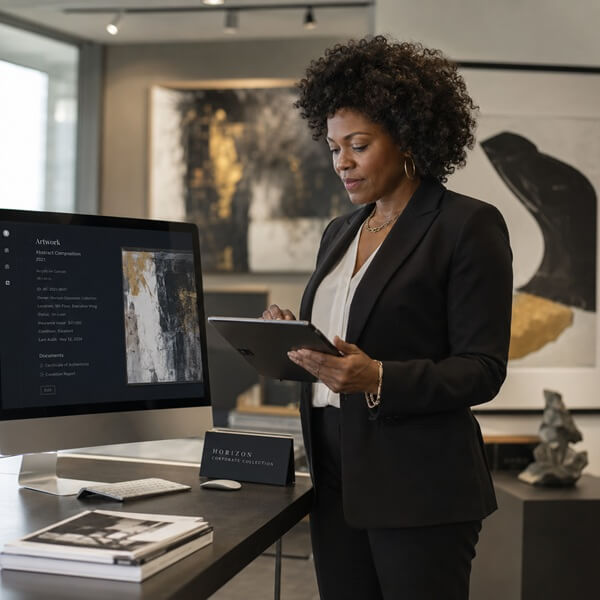
For distributed collections, that shift is significant. It turns provenance from a difficult research exercise into a more manageable, ongoing documentation practice.
How Onward Supports Provenance Management Across Collections
Onward supports provenance management by giving organizations a centralized place to manage artworks, records, and operational details across distributed collections. Rather than relying on fragmented spreadsheets and disconnected document folders, teams can organize information around each artwork record and keep supporting materials accessible.
With inventory management for art collections, organizations can maintain structured artwork profiles that support better recordkeeping from the start. Those profiles can serve as the foundation for provenance documentation by bringing together object details, related files, and collection data in one system.
Onward also helps through document storage and attachment management. Provenance-related files such as invoices, condition reports, certificates, and loan records can be associated with specific artworks so they are easier to retrieve when needed. That is especially useful for organizations handling acquisitions, loans, insurance reviews, and internal reporting across multiple locations.
For collections spread across offices, campuses, or storage facilities, location management for artworks supports visibility into where works are and how they move. That operational history complements provenance workflows by preserving clearer records around custody and movement.
Teams also benefit from reporting and collaboration features. With analytics and reporting tools for collection oversight, stakeholders can review collection information more efficiently and identify gaps that need attention. Multi-user access supports coordination across collection managers, curators, registrars, and risk teams without forcing everyone to rely on separate spreadsheets or inboxes.
The practical advantage is simplicity. Onward helps organizations move from fragmented documentation habits toward a centralized workflow that supports provenance, inventory management, document storage, reporting, and location tracking together.