If your organization manages corporate art, you’ve likely faced this scenario: a facilities director in 2026 trying to track 800+ artworks across 12 offices in New York, London, and Singapore. The records live in spreadsheets, email threads, and a binder held by a consultant who retired last year. Leadership asks for the total insured value by location. Your ESG team needs a breakdown of works by emerging artists. Your broker wants an updated insurance schedule by Friday. Complex collections often bring in a corporate art consultant.
Table of Contents
What Is Art Collection Management Software?
The Current State of Corporate Art Collection Management in 2026
How Onward Approaches Art Collection Management Software
Best Practices for Managing a Corporate Art Collection with Software
How to Evaluate Art Collection Management Software Vendors
Getting Started with Onward
Frequently Asked Questions
This is where art collection management software becomes essential. Without centralized tools, you’re left hunting through PDFs, guessing at current locations, and manually reconciling outdated appraisals. The result is operational friction, compliance risk, and missed opportunities to leverage your collection strategically.
This guide explains what modern collection management software does, the challenges it solves, how Onward addresses them, and how to get started.
What Is Art Collection Management Software?
Art collection management software is a cloud-based platform designed to organize, track, and manage artworks and collections. Unlike generic tools like Excel, SharePoint, or basic digital asset management systems, purpose-built software provides structured functionality for the unique requirements of art stewardship.
The functional scope covers inventory and cataloging, location and movement tracking, loan management, provenance documentation, insurance and valuations, condition reporting, virtual exhibitions, and analytics. These systems sit between heavyweight museum platforms like TMS or AMS and lightweight collector-focused tools.
For this guide, the focus is on organizational and corporate collections rather than private collectors or galleries managing sales inventory — for the latter, dedicated gallery inventory software covers that specialized workflow.
The Current State of Corporate Art Collection Management in 2026
Corporate art acquisition expanded significantly from 2018 to 2025. Organizations commission and acquire art for workplace wellness, ESG commitments, DEI initiatives, and community engagement. Many now manage hundreds or thousands of pieces distributed across multiple offices and storage facilities. For more context, see the Getty Research Institute tools. Buying with intent means following a clear art acquisition strategy.
The typical starting point remains fragmented: records scattered across legacy databases, email chains, PDFs in shared drives, and paper archives held by individual staff. When staff members who maintained institutional knowledge depart, organizations face continuity risk.
Regulatory context has heightened. Insurance audits require accurate valuations. Financial reporting demands proper asset tracking. Remote and hybrid work arrangements make centralized, accessible collection data essential.
Key Challenges Organizations Face Without Robust Software
Without purpose-built art collection software, organizations encounter predictable friction points. Teams comparing tools often start by shortlisting the best art software for corporate offices for their needs.
Many of these challenges stem from relying on disconnected systems. Modern art collection software brings inventory, documentation, reporting, and location tracking into a single platform. Serious collectors increasingly manage holdings through art collection software.
- Incomplete inventory data. Records lack standardized fields for dimensions, medium, artist biographical data, edition numbers, acquisition terms, and copyright notes. Inconsistent naming conventions make searching difficult.
- Poor location tracking. Artworks move between floors, offices, and storage without updated records. A documented 2024 example: an organization discovered during renovation that several pieces were unaccounted for. Another found a $400,000 sculpture had been in storage for three years, forgotten.
- Loan and exhibition complexity. Managing internal rotations, external loans to museums, and temporary installations requires tracking dates, conditions, agreements, and checklists across multiple systems.
- Insurance and valuation gaps. Appraisals from five or ten years ago remain scattered across email. Generating accurate insurance schedules for brokers takes days of spreadsheet merging.
- Scattered documentation. Invoices, condition reports, certificates of authenticity, and correspondence live in individual email accounts. Assembling a complete provenance package takes hours.
- Limited analytics. Answering basic questions—total value by location, works by medium, pieces supporting DEI initiatives—requires extensive manual aggregation.
- Security and continuity risk. When the person holding collection knowledge leaves, organizations lose institutional memory unless records are centralized.
Core Capabilities to Look For in Art Collection Management Software
When evaluating platforms, prioritize these capabilities:
- Inventory and cataloging: Detailed object records covering artist, title, year, medium, dimensions, edition, acquisition data, legal rights, and tags. Support for high-resolution images and photos.
- Location and movement tracking: Multi-site architecture with granular location hierarchies (building, floor, room). Full movement history with timestamps and responsible staff.
- Loan and exhibition management: Track internal rotations, external loans, virtual exhibitions, online viewing rooms, and condition checks with due dates and reminders.
- Provenance and documents: Attach invoices, appraisals, condition reports, conservation records, and correspondence as searchable objects. Support scans and common file formats.
- Insurance and valuations: Store appraised value, appraisal dates, insurers, policy numbers. Generate insurance schedules filtered by location or threshold.
- Analytics and reporting: Dashboards showing collection value by site, breakdown by medium or artist, and reports for finance, DEI, and leadership.
- Collaboration and permissions: Role-based access for internal team members and controlled access for external partners like conservators and appraisers.
- Secure cloud architecture: Encryption, regular backups, SSO integration, and compliance with enterprise security standards.
How Onward Approaches Art Collection Management Software
Onward is an purpose-built, cloud-based platform purpose-built for corporate and organizational collections. It’s lighter and more intuitive than full museum systems like TMS, but more structured and enterprise-ready than collector-focused tools such as Artwork Archive or Artlogic.
Onward serves teams in real estate, facilities, corporate art programs, DEI offices, and family offices who need reliability without museum-level complexity.
Centralized Inventory and Location Tracking
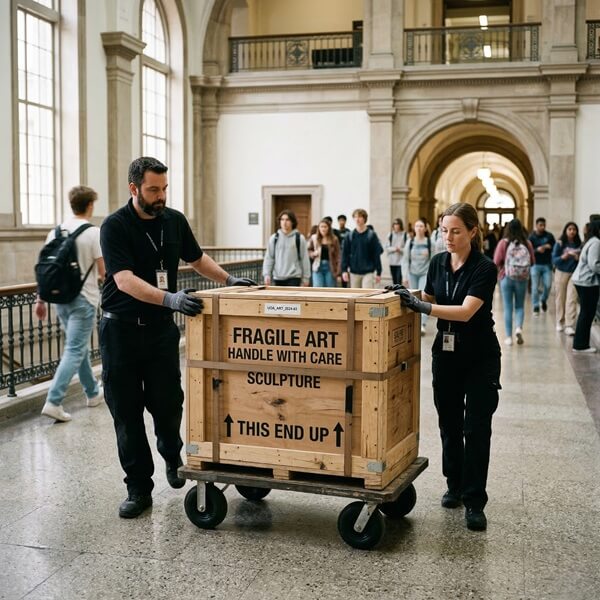
Onward creates a single source of truth with standardized fields, controlled vocabularies, and configurable templates. A financial services firm with 1,500 works across 20 branches can track moves between New York, Chicago, and Dallas with precise room-level locations. Users log moves with effective dates, responsible staff, and reasons—renovation, leadership change, exhibition rotation.
Before selecting software, it helps to understand the fundamentals of cataloging artwork so your data model reflects real-world collection needs.
Provenance, Documents, and Compliance in One Place
Attach and browse invoices, certificates of authenticity, provenance research, conservation archives, appraisals, and legal agreements directly on each object record. When your legal team reviews a potential deaccession, you can produce a complete documentation packet in minutes. Version history ensures updates are tracked across your organization.
Loan, Exhibition, and Rotation Management
Onward tracks internal rotations and external loans with start and end dates, conditions, and checklists. Coordinating a six-month loan of five works to a partner museum becomes straightforward with reminders for mid-loan condition checks. The platform supports virtual exhibitions and internal digital showcases for remote employees, making your collection accessible across operating systems and device types—desktop, Mac, or mobile browser.
Insurance, Valuations, and Risk Reporting
Track appraised values, appraisal dates, appraisers, and insurers for each work. Run an up-to-date insurance schedule by location, filtered by works over a value threshold. Generate a 2026 insurance summary for your broker in minutes instead of days spent merging data from multiple sources. Store claim documentation alongside object records for future reviews.
Analytics and Executive-Ready Reporting
Dashboards visualize total insured value by location, works by medium, by artist, and by acquisition year. Create quarterly reports for the CFO or annual ESG reporting showing representation of emerging artists. Export to PDF, Excel, or slide-ready summaries. Organizations using Onward report reduced time compiling reports and fewer data discrepancies.
Cloud-Based Art Collection Management
Modern organizations need a collection of data that is accessible from anywhere. Cloud-based art collection management allows authorized users to access inventory records, valuations, provenance documentation, condition reports, and location data without relying on local files or disconnected spreadsheets.
For organizations with artwork distributed across multiple offices, a cloud-based platform creates a centralized source of truth. A facilities manager in Chicago, a risk manager in New York, and an executive team in London can all work from the same current records. Changes are reflected in real time, decreasing the risk of duplicate records, outdated information, and reporting inconsistencies.
Cloud architecture also improves security and business continuity. Rather than relying on individual employees to maintain institutional knowledge, organizations can preserve collection records in a secure, searchable system with role-based permissions, backups, and time-stamped updates.
Remote Art Collection Monitoring
As collections become more geographically distributed, organizations need better visibility into where artwork is located and how it is being used. Remote art collection monitoring provides oversight without requiring staff to physically inspect every location.
With centralized tracking, organizations can monitor artwork across corporate offices, campuses, healthcare facilities, and storage locations. Teams can review movement history, verify current locations, track upcoming loans, and identify gaps in documentation from a single dashboard.
Such visibility becomes especially valuable during renovations, office relocations, insurance reviews, and audits. Instead of requesting updates from multiple stakeholders, collection managers can access current information immediately and take informed decisions based on accurate data.
Private Art Collection Management Software
While many collection management platforms focus on museums or galleries, private art collection management software serves a different set of needs. Family offices, foundations, corporate executives, and private collectors often require stronger privacy controls, streamlined reporting, and long-term stewardship tools.
These collections frequently span multiple residences, offices, and storage facilities while engaging multiple stakeholders, including advisors, appraisers, attorneys, and family members. Keeping precise records among generations requires more than a spreadsheet.
For collections with active lending programs, art logistics integrations can automate shipping and condition-reporting workflows.
Purpose-built software provides protected access controls, centralized documentation, valuation tracking, and extensive reporting capabilities that help preserve both the financial and historical value of a collection over time.
Digital Art Collection Management
Digital art collection management goes beyond simply storing images of artwork. It entails maintaining a complete digital record of each object, including provenance, acquisition details, valuation history, condition reports, conservation records, legal documentation, and location tracking.
Organizations that adopt digital collection management benefit from faster reporting, improved searchability, and stronger governance. Rather than searching through email chains or shared drives, stakeholders may access a complete object history within seconds. Underneath that speed is reliable digital tracking, logging every move and update so the record stays current.
As collections grow, digital management creates a scalable foundation that supports acquisitions, loans, insurance reviews, ESG reporting, and long-term collection planning.
Best Software for Managing Art Collections
The best software for managing art collections should help organizations track artwork, manage documentation, monitor locations, generate reports, and maintain a centralized source of truth across the entire collection. The right solution depends on the size, complexity, and goals of the organization.
Spreadsheets may work for small collections, but become difficult to maintain as collections grow. Generic document management systems can store records but lack the specialized functionality needed for tracking artwork movements, provenance, loans, and valuations.
Museum collection management systems offer extensive capabilities yet are often more complex than corporate organizations require. Collector-focused tools may be easier to use but can lack enterprise-level controls and reporting capabilities.
Organizations should look for software that balances usability with strong collection management features. The right platform should provide inventory management, location tracking, document storage, reporting, analytics, security controls, and joint effort tools without creating unnecessary complexity. For many corporate collections, family offices, universities, medical systems, and financial institutions, purpose-built services like Onward offer that balance.
Benefits You’ll See from the Right Art Collection Management Software
The benefits are operational and strategic.
- Time savings: Facilities and art program staff recover hours monthly previously spent hunting for files and updating spreadsheets. Realistic estimates suggest 200-400 hours recovered annually for a 1,500-piece collection.
- Reduced risk: Fewer misplaced works, clearer insurance coverage, and better documentation for audits, donations, and claims.
- Stakeholder confidence: Leadership, finance, and legal teams trust the data and see consistent, accurate reports.
- Better collection utilization: Easier planning of rotations, community loans, and programming tied to business goals.
- Institutional continuity: Knowledge stays with the organization when curators, consultants, or coordinators move on.
Organizations using Onward report closing quarterly reporting cycles two days faster and consolidating multiple legacy systems into one flexible platform.
Best Practices for Managing a Corporate Art Collection with Software
- Start with a structured inventory project: Define fields, standards for artist naming conventions and date formats, and priorities for backlog data entry.
- Involve stakeholders early: Connect facilities, risk, finance, legal, brand, and external advisors before implementation.
- Establish data governance: Assign ownership, set update rules, define required fields, and schedule periodic reviews.
- Standardize workflows: Document how acquisitions, deaccessions, loans, and moves are recorded.
- Train teams and document processes: Create short SOPs and quick-reference guides. Edit and update them as your system evolves.
- Use analytics regularly: Build a monthly or quarterly cadence to review dashboards and adjust strategy.
How to Evaluate Art Collection Management Software Vendors
Consider organizational fit first. Museum-focused systems are sophisticated but often over-engineered for corporate collections. Collector-focused tools may lack multi-site features and administrative controls. Look for platforms designed for law firms, universities, healthcare systems, and financial institutions.
Prioritize usability for non-museum staff. Your facilities team needs a user friendly, intuitive interface with low training overhead. Request demos and have non-technical staff test basic tasks.
Evaluate integration requirements (SSO, API, data export), support quality (data migration assistance, training, SLAs), and vendor sustainability (track record, roadmap, financial stability).
Getting Started with Onward
The first 60-90 days with Onward follow a clear path.
- Discovery: Map your current records—spreadsheets, legacy databases, PDFs—and clarify goals: inventory accuracy, insurance readiness, loan visibility.
- Data migration: Import existing data, resolve duplicates, normalize fields. Onward’s team provides guidance throughout.
- Configuration: Set up locations, user roles, workflows, and reports tailored to your organizational structure.
- Training and rollout: Short online sessions for key user groups, plus documentation to help new staff adopt quickly.
Discover how Onward helps streamline your collection management..
Transform Your Corporate Art Collection Management
The scenario from the opening—hunting through spreadsheets, uncertain locations, last-minute insurance reports—doesn’t have to be your reality. Modern art collection management software addresses these challenges with centralized, secure, and searchable data.
Onward offers museum-grade structure with corporate-friendly simplicity. You gain control over your collection, reduce risk, and unlock strategic value from your art assets.
Frequently Asked Questions
What Is Art Collection Management Software?
Art collection management software is a specialized platform that helps organizations catalog, track, manage, and report on artwork and collections. It centralizes inventory records, provenance documentation, valuations, condition reports, location tracking, loan management, and analytics in a single system.
What Is the Best Software for Managing Art Collections?
The best software for managing art collections depends on your organization’s size and needs. Corporate collections, family offices, universities, healthcare systems, and financial institutions typically require more robust tools than spreadsheets or generic document management systems can provide. Look for a platform that combines inventory tracking, reporting, document management, security controls, and multi-location support.
How Does Cloud-Based Art Collection Management Work?
Cloud-based art collection management stores collection data in a secure online platform that authorized users can access from anywhere. This allows teams across multiple offices, departments, or locations to work from the same records in real time while maintaining security, permissions, backups, and time-stamped updates.
Why Is Remote Art Collection Monitoring Important?
Remote art collection monitoring helps organizations maintain visibility across distributed collections. Collection managers can track artwork locations, review movement history, monitor loans, access documentation, and generate reports without physically visiting each site. This improves operational efficiency while reducing risk.
Can Private Art Collections Use Collection Management Software?
Yes. Private art collection management software is commonly used by family offices, foundations, corporate executives, and private collectors. These platforms help organize collection records, valuations, provenance documents, insurance schedules, and location information while providing secure access controls for advisors and stakeholders.
What Is the Difference Between Art Inventory Software and Art Collection Management Software?
Art inventory software focuses primarily on tracking artwork records and locations. Art collection management software provides broader functionality, including provenance tracking, loan management, valuation reporting, condition assessments, document storage, analytics, and collaboration tools.