Table of Contents
- What defines a “serious” art collection today?
- Why spreadsheets are no longer enough
- What to look for in the best art collection software
- Categories of art collection software
- Why Onward is built for serious collectors
- How art collection software changes the way you collect
- Getting Started Using Onward
If you are managing a growing art collection, choosing the right art collection software is no longer optional. Whether your works are displayed across multiple residences, offices, or storage facilities, you need a system that keeps everything organized, accessible, and protected. Choosing the right art software for corporate offices makes that ongoing tracking far less manual. Keeping all of it searchable starts with a solid art collection database. Knowing where each piece sits calls for physical asset tracking software. Valuable holdings deserve proper art collection insurance.
This guide breaks down what serious collectors should look for in art collection management tools, why traditional methods fall short, and how modern platforms like Onward are redefining how collections are tracked and managed.
What defines a “serious” art collection today?
A serious art collection is not just about value, although many collections exceed seven or eight figures. What truly defines it is complexity.
Today’s collectors often manage artworks across multiple properties, cities, and even countries. Some pieces may be displayed in living or working spaces, while others are in storage, in transit, or temporarily placed with partners. Alongside the physical artworks comes a growing body of documentation, including provenance records, invoices, condition reports, and insurance details.
As collections expand, they also become more operational. It becomes increasingly difficult to keep track of where each piece is located, how its value has changed, or what actions are needed next. What begins as a personal passion gradually requires structured management. This is the point where art collection software becomes essential rather than optional.
Why spreadsheets are no longer enough
Many collectors begin with spreadsheets because they are simple and familiar. At first, they seem flexible and easy to maintain.
However, as the collection grows, spreadsheets tend to introduce friction instead of clarity. Information becomes fragmented across multiple versions, images are often missing or stored separately, and there is no reliable way to track how artworks move over time. Important details such as valuation updates or condition notes can easily be lost or overwritten.
Another major limitation is the lack of structure. Spreadsheets do not enforce consistency, which means that data about artists, provenance, or insurance may be incomplete or formatted differently across entries. This creates challenges when trying to analyze or share information.
Over time, these issues translate into real risks. Collectors may struggle to provide accurate information to insurers, lose track of artworks during moves, or spend unnecessary time compiling reports for advisors. For serious collections, relying on spreadsheets is no longer sustainable. A dedicated art collection software solution provides the structure, reliability, and visibility that spreadsheets simply cannot.

What to look for in the best art collection software
The best art collection software is designed to bring together structure and ease of use. It should not feel like a complicated database, but it should still provide the depth needed to manage a valuable collection properly.
At its core, the software should offer a centralized inventory where each artwork has a complete and detailed record. This includes high-quality images, artist information, acquisition details, valuation data, and supporting documentation. Having everything in one place eliminates the need to search across folders, emails, and files.
Location tracking is another critical feature, especially for collectors with multiple properties or storage locations. A well-designed system allows you to organize locations hierarchically, making it easy to understand exactly where each artwork is at any given time.
Beyond current location, the software should also track movement history. This means recording when an artwork was moved, who was responsible, and any relevant notes. Over time, this creates a reliable record that is invaluable for both operational clarity and insurance purposes.
Equally important is the ability to store documents and images directly alongside each artwork. Provenance records, certificates of authenticity, condition reports, and insurance documents should all be easily accessible within the system. This eliminates the risk of losing critical information and makes it easier to share details when needed.
Loan management is another essential capability for serious collectors. If artworks are placed in galleries, museums, or external spaces, the software should clearly show where each piece is, who is responsible for it, and when it is expected to return.
Finally, the software should provide analytics and reporting capabilities. As collections grow, data becomes increasingly valuable. Being able to track overall collection value, identify trends, and generate reports for advisors or insurers can significantly improve decision-making.
All of this must be supported by an intuitive interface. The best systems are those that collectors, family members, or assistants can use without needing extensive training.
Categories of art collection software
When evaluating options, most tools fall into three categories:
1. Basic inventory tools
These are simple and affordable but limited. They may work for small collections but struggle as complexity increases.
2. Museum-grade systems
Highly detailed and powerful, but often complex and difficult to use. They are designed for institutions, not private collectors.
3. Modern collection management platforms
These tools are designed specifically for collectors and organizations that need both usability and structure.
This is where platforms like Onward stand out.
Why Onward is built for serious collectors
Onward is designed for collectors and organizations managing valuable, distributed collections.
It focuses on the essentials without unnecessary complexity.
| Capability | How Onward Supports Serious Collectors |
| 1. Inventory Management | Onward provides structured, detailed records for every artwork, including images, documents, and valuation data. |
| 2. Location Tracking | Track artworks across multiple properties with a clear hierarchical structure. Whether your collection spans homes, offices, or storage, you always know where everything is. |
| 3. Loan Management | Manage artworks on loan with full visibility into location, agreements, and timelines. |
| 4. Task Management | Assign and track tasks such as condition checks, moves, or documentation updates. |
| 5. Analytics & Reporting | Gain insights into your collection, from value tracking to operational metrics. |
| 6. Private Rooms | Share selected parts of your collection securely with advisors, partners, or guests. |
What makes Onward different is its balance. It is powerful enough for complex collections but simple enough to use daily.
How art collection software changes the way you collect
Implementing the right art collection software does more than improve organization. It fundamentally changes how collectors interact with their collections.
With a centralized system, information becomes immediately accessible. Decisions can be made more quickly, whether related to acquisitions, placements, or loans. Risk is reduced because records are accurate and up to date, improving insurance coverage and compliance.
Collaboration also becomes easier. Advisors, family members, and partners can access the information they need without relying on manual updates or fragmented records.
Ultimately, the collection becomes more than a static set of assets. It becomes a dynamic, well-managed portfolio that can be actively used, shared, and developed over time.
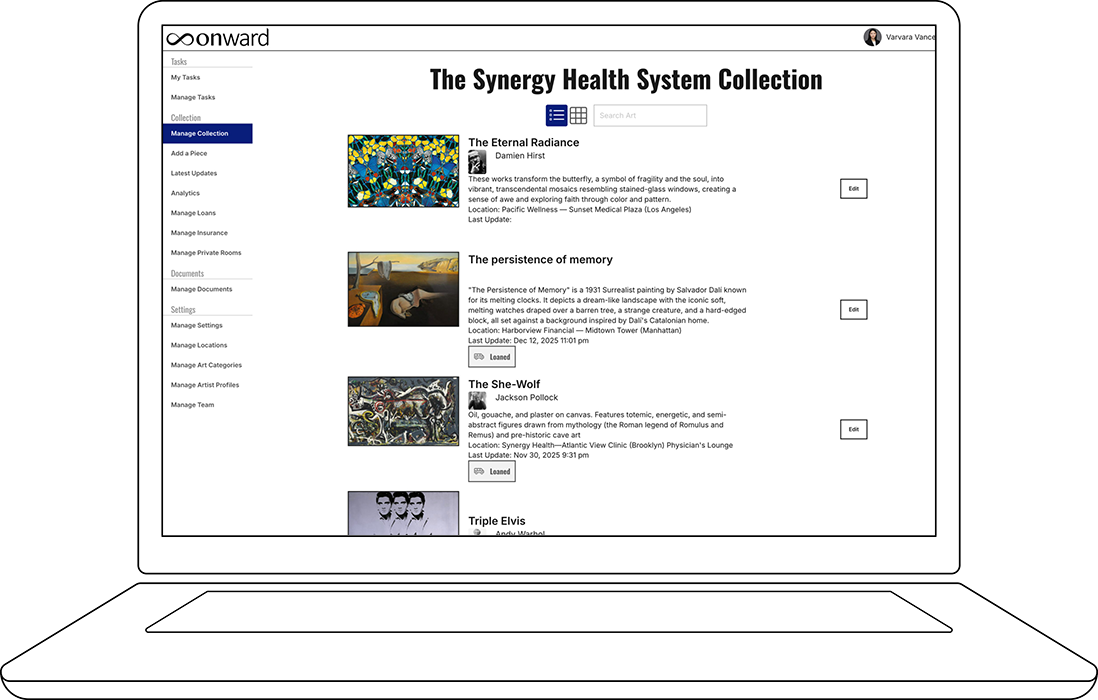
Getting Started Using Onward
Many collectors are transitioning from spreadsheets and scattered records to structured systems in 2026. The process does not need to be complicated.
Start by organizing your collection inside Onward, even if you begin with partial data. Upload images, invoices, and documentation for each artwork, and define your locations across properties or storage spaces.
From there, identify gaps such as missing valuations or incomplete records. As your data becomes centralized, you will have a clear, exportable overview of your collection that can be shared with advisors, insurers, or partners.
Ready to take control of your collection? Request a guided tour to see how Onward can support your specific setup, or get started today and begin building a system that grows with your collection.