If your company’s art is spread across offices, campuses, or storage, determining how much insurance you need is not as simple as assigning a total value. This guide explains how to calculate proper coverage, align valuations, and manage risk across complex, high-value collections. Moving works safely between sites is the job of professional art handling services. Protecting that value over time is what art asset management delivers. Protecting valuable works starts with sound art security.
Quick Navigation:
- What “enough art collection insurance” actually means
- How internal teams influence coverage
- Key factors that determine insurance needs
- Aligning valuations with coverage
- Why multi-location collections are complex
- Questions to ask your insurer
- How Onward supports insurance management
- Final checklist and next steps
What “enough art collection insurance” actually means
Determining how much art collection insurance you need starts with a simple idea that quickly becomes complex in practice. Many organizations assume that coverage equals the total value of their collection. In reality, “enough insurance” is about structuring coverage correctly, not just assigning a number.
Art collections are dynamic assets. Values change, works move between locations, and risk exposure varies depending on how pieces are stored, displayed, or transported. Proper insurance must reflect all of these variables.
There are several valuation types that play a role in insurance decisions. Purchase price reflects what was originally paid, but it often becomes irrelevant as the market evolves. Appraised value represents a professional estimate at a specific point in time and is typically used for insurance underwriting. Fair market value reflects what a work would sell for in current conditions. Insured value is the number defined in the policy, which may or may not align with the latest appraisal.
The gap between these values is where risk emerges. If insured value lags behind market appreciation — a key corporate art investment factor to monitor — collections become underinsured. If it exceeds realistic market value, organizations may overpay for premiums without meaningful benefit.
For corporate and institutional collections, the complexity increases significantly. Unlike a single-site private collection, corporate art collections are often distributed across offices, storage facilities, and loan environments. Coverage must account not only for value, but also for where each work is located and how it is used.
In practice, “enough insurance” means aligning accurate valuations with the right policy structures, while continuously updating both as the collection evolves.
How internal teams influence coverage
Art collection insurance is not determined by a single decision maker. It is the result of collaboration across risk, finance, and operational teams, each bringing a different perspective to the process.
Risk and insurance teams focus on exposure. Their role is to evaluate policy limits, sublimits, deductibles, and coverage conditions. They assess where vulnerabilities exist, whether in transit, storage, or public display, and ensure that policies reflect real-world scenarios. For them, the key question is not just how much coverage exists, but whether it applies correctly across all risk situations.
Finance teams approach the problem from a different angle. They require accurate and defensible valuations that align with financial reporting, audits, and asset management frameworks. Discrepancies between insured value and reported value can create complications during audits or claims. Finance leaders often push for consistency, documentation, and traceability in valuation data.
Facilities teams and collection managers provide the operational layer that makes insurance decisions realistic. They track where artworks are physically located, monitor environmental conditions, and manage movement between sites. Their data directly impacts risk assessments. A work stored in a controlled facility carries a different risk profile than one displayed in a high-traffic office or transported internationally.
 Art Insurance“/>
The challenge is that these teams often operate with fragmented data. Spreadsheets, email threads, and static documents create gaps that make it difficult to align decisions. Without a centralized view, it becomes harder to confidently answer a basic question such as how much art insurance do I need.
Effective insurance coverage depends on bringing these perspectives together through shared, accurate data.
Key factors that determine insurance needs
To calculate how much art collection insurance is required, organizations need a structured way to evaluate the variables that drive risk and value. Four factors consistently shape insurance decisions.
The first is total collection value and its distribution. Not all artworks carry equal weight. A small percentage of high-value works often represents a large portion of the total risk. Identifying these concentration points is essential for setting appropriate policy limits and sublimits.
The second is location-based risk. Artworks located in headquarters offices, regional branches, storage facilities, or external venues all carry different exposure levels. Environmental conditions, security infrastructure, and geographic risks such as climate or political instability all influence insurance requirements.
The third factor is market volatility and appreciation. Art is not a static asset class. Values can rise significantly over time, especially for sought-after artists or categories. Without regular updates, insurance coverage can quickly fall behind actual market value.
The fourth factor is movement and external exposure. Collections that frequently loan works to exhibitions, transport pieces between locations, or engage in public display face higher risk. Transit, handling, and temporary installations introduce variables that must be reflected in coverage.
Experienced teams know that different types of corporate art valuation: insurance value, fair market value & other key standards is central to getting this right. Reliable art valuation underpins every one of those standards.
The table below summarizes how these factors translate into insurance considerations:
| Factor | What to Assess | Insurance Impact |
| Collection Value | Total value and high-value concentration | Policy limits and sublimits |
| Location | Offices, storage, external venues | Risk-based premium adjustments |
| Market Trends | Appreciation and volatility | Frequency of reappraisal |
| Movement | Loans, transport, exhibitions | Transit coverage and conditions |
A structured evaluation of these elements allows organizations to move from guesswork to informed decision-making in art collection risk management. Thorough art evaluation is what makes that shift possible.
Aligning valuations with coverage
Valuation accuracy sits at the center of every insurance decision. Without reliable valuation data, it is impossible to determine whether coverage is adequate.
Different valuation types serve different purposes. Appraised value is typically used to set insured value, but it must be current to remain relevant. Fair market value provides context for potential sale scenarios, while historical purchase price is mainly useful for internal reference.
The most common issue in corporate art collection insurance is outdated appraisals. When valuations are not updated regularly, insured values drift away from reality. This creates two risks. Underinsurance leaves organizations exposed in the event of a loss, while overinsurance results in unnecessary premium costs.
Another important factor is valuation history. Insurers and auditors often require evidence of how values have changed over time. A clear record of appraisals, including dates and methodologies, strengthens claim readiness and reduces disputes.
Centralizing valuation data improves both accuracy and transparency. Instead of relying on static reports or disconnected spreadsheets, organizations benefit from maintaining a continuous record of value changes at the object level.
Example: Artwork Record with Insurance and Valuation Fields
| Field | Details |
| Artwork | Untitled Abstract Painting |
| Artist | Contemporary Artist |
| Location | Milan Headquarters – Floor 3 |
| Appraised Value (2024) | €250,000 |
| Previous Appraisal (2021) | €180,000 |
| Insured Value | €240,000 |
| Insurance Policy | Fine Art Policy A-1023 |
| Coverage Type | All-risk including transit |
| Last Condition Report | January 2025 |
| Documents Attached | Appraisal PDF, Condition Report, Insurance Certificate |
This type of structured record allows teams to quickly verify whether coverage aligns with current value and risk exposure.
Why multi-location collections are complex
Corporate art collections rarely exist in a single, controlled environment. They are distributed across cities, countries, and operational contexts, which introduces significant complexity into insurance calculations.
Each location carries its own risk profile. A secure storage facility with climate control is fundamentally different from a public lobby or a temporary exhibition space. Insurance policies must reflect these differences, often requiring multiple coverage layers or location-specific conditions.
Movement adds another layer of complexity. When artworks are transported between offices or loaned to external institutions, responsibility shifts and risk increases. Transit coverage must be clearly defined, including who is responsible at each stage and what conditions apply.
Policy structures also become more complicated. Organizations may operate under a master policy with sublimits for specific locations or categories of works. Alternatively, they may maintain separate policies for different regions or subsidiaries. Coordinating these structures requires precise, up-to-date information.
The biggest challenge is data fragmentation. When location, valuation, and movement data are stored in different systems or spreadsheets, it becomes difficult to maintain a unified view of risk. This is where many organizations struggle to accurately determine how much art insurance they need.
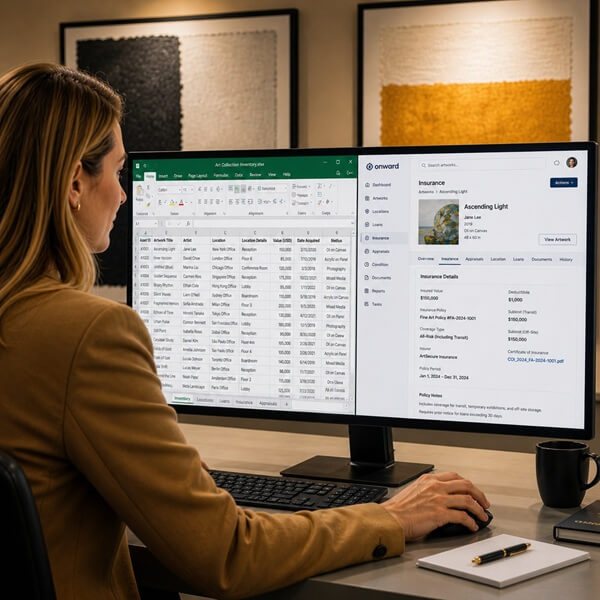
Spreadsheet vs Centralized System
Spreadsheets often fail in multi-location scenarios because they are static, difficult to update in real time, and prone to errors. They do not easily capture movement history or link documents such as appraisals and insurance certificates.
A centralized system, on the other hand, provides real-time visibility across locations. It connects artworks to their current and historical locations, links valuation data to insurance records, and enables reporting across the entire collection. This level of integration is essential for managing distributed collections effectively.
Questions to ask your insurer
Reviewing art collection insurance requires asking the right questions. The goal is to ensure that coverage aligns with both current value and real-world risk exposure.
Start with valuation. How often should appraisals be updated, and what methodology is used? Does the policy allow for automatic adjustments between appraisal cycles, or does coverage remain fixed until formally updated?
Next, consider coverage limits and sublimits. Are high-value works fully covered, or are there caps that could create exposure? How do deductibles apply across different types of claims?
Location-based risk is another critical area. Does the policy differentiate between storage, display, and transit? Are all locations covered equally, or are there exclusions based on geography or use?
Documentation is equally important. What records are required to support a claim? Are condition reports, appraisal documents, and ownership records sufficient and up to date?
Finally, assess operational alignment. Does the policy reflect how the collection is actually managed, including movement, loans, and multi-site distribution?
By systematically addressing these questions, organizations can move from generic coverage to a tailored insurance strategy.
How Onward supports insurance management
Managing art collection insurance at scale requires more than periodic reviews. It requires continuous visibility into valuation, location, and risk data. This is where Onward art management provides a clear advantage.
Onward centralizes all collection data into a single platform. Through Inventory Management, teams can maintain detailed records for each artwork, including valuation history and insurance coverage fields. This eliminates the need to reconcile multiple spreadsheets or documents.
With Location Management, organizations can track artworks across offices, storage facilities, and external venues in real time. This ensures that insurance coverage reflects actual location and exposure.
The platform also supports document storage, allowing teams to attach appraisals, insurance policies, and condition reports directly to each artwork record. This improves audit readiness and simplifies claims.
Through Analytics & Reporting, users can generate collection-wide insights, such as total insured value by location or identification of underinsured works. These reports support both internal decision-making and external communication with insurers and auditors.
By connecting valuation, location, and documentation data, Onward enables organizations to confidently answer the question of how much art insurance they need, while maintaining alignment as the collection evolves.
Final checklist and next steps
Determining how much insurance you need for an art collection becomes manageable when broken into clear, actionable steps.
- Start by reviewing valuations. Ensure that all significant works have up-to-date appraisals and that insured values reflect current market conditions. Identify any gaps where values may have changed significantly.
- Next, evaluate coverage structure. Confirm that policy limits and sublimits align with the distribution of value across the collection. Pay particular attention to high-value works and locations with elevated risk.
- Assess location and movement. Verify that all locations are accounted for and that transit and loan scenarios are covered appropriately. Ensure that responsibilities are clearly defined when artworks move between sites or external institutions.
- Review documentation. Make sure that appraisal reports, condition records, and insurance documents are complete and easily accessible. This is critical for both audits and claims.
- Finally, align teams. Bring together risk, finance, and operational stakeholders to ensure that decisions are based on shared, accurate data.
A practical approach is to run a pilot review of a subset of artworks. This allows you to test your process, identify gaps, and refine your approach before scaling across the entire collection.
If your organization is managing a multi-location collection, consider moving from spreadsheets to a centralized system. Platforms like Onward make it easier to track valuations, manage risk, and maintain insurance alignment over time.
Assess your current coverage and request a guided tour of Onward to see how centralized art collection management can simplify insurance, valuation, and risk tracking across your entire portfolio.