Workplace art encompasses far more than decor hanging on office walls. It includes paintings, sculptures, digital displays, and installations strategically placed throughout corporate environments to shape employee experience, reinforce culture, and communicate values to clients and visitors.
If your organization manages a corporate art collection, you’ve likely discovered that selecting the right artwork involves balancing aesthetics with business outcomes. Different art types serve distinct purposes—nature imagery supports employee well being, while abstract pieces stimulate creativity and innovation. Understanding these distinctions helps you build a collection that delivers measurable positive impact.
How We Chose the Best Workplace Art Categories
Our evaluation criteria focus on three core factors:
- Employee wellbeing impact – Does research support stress reduction and cognitive benefits?
- Cultural alignment – How well does the art communicate your organization’s mission and values?
- Ease of management – What are the maintenance requirements and cataloging needs?
Evidence from experimental psychology and environmental research confirms that art selection directly influences mood, productivity, and engagement. Findings consistently show that employees feel more connected to organizations that invest thoughtfully in their workplace environment.
Proper cataloging and management systems matter for corporate collections. Tracking provenance, fine art insurance, condition reports, and rotation schedules protects your investment and ensures artwork continues serving its intended purpose.

Top 5 Types of Workplace Art for Corporate Organizations
1. Nature-Themed and Landscape Art
Nature-themed artwork—forest scenes, ocean vistas, mountain panoramas, and botanical illustrations—remains among the most prevalent choices in corporate settings. These pieces appear in mediums ranging from photography to oils and watercolors.
Why It Stands Out: Researchers have documented that exposure to nature imagery activates the parasympathetic nervous system. Studies published in environmental psychology journals show heart rate reductions of 5-10% and concentration improvements of 15-20% in task-oriented spaces.
Best For: High-stress environments including healthcare organizations, financial institutions, and trading floors benefit most from biophilic art’s calming effects.
Key Strengths:
- Reduces employee stress and blood pressure through simulated escapism
- Improves focus by replenishing directed attention depleted by screen work
- Appeals broadly across demographics without cultural specificity
Possible Limitations:
- Can feel generic if not carefully curated with attention to detail
- May lack direct connection to company culture or identity
2. Local Artist Collections
Featuring local artists involves commissioning or acquiring works from regional talents—from murals depicting city landmarks to portraits of community figures displayed in rotating gallery wall arrangements.
Why It Stands Out: This approach creates authentic community connection while supporting the local economy. Companies purchasing directly from artists often pay 30-50% above gallery rates, generating storytelling opportunities that strengthen employee pride.
Best For: Organizations emphasizing community engagement, regional banks, nonprofits, and businesses with strong local presence.
Key Strengths:
- Builds relationships through artist meet-and-greets that boost internal morale
- Provides conversation starters and bridge-building opportunities with visitors
- Reflects values of supporting emerging talent and diversity
Possible Limitations:
- Requires ongoing curation and artist relationship management
- Quality and style consistency can vary without proper vetting processes
3. Abstract Contemporary Pieces
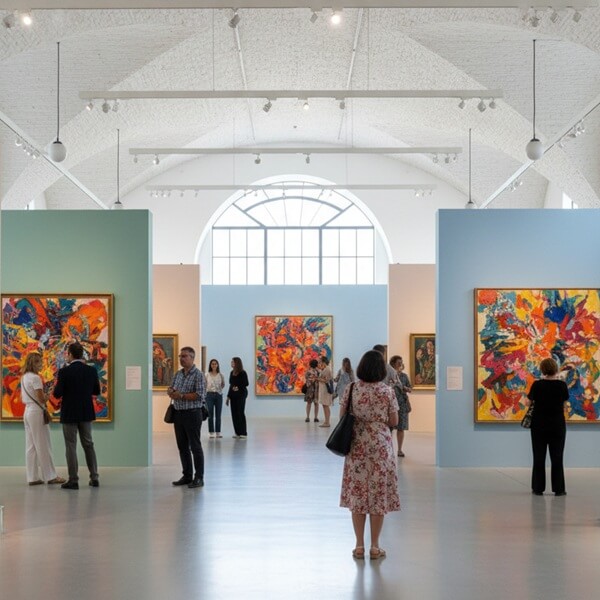
Abstract contemporary art features non-representational forms, bold geometries, and vibrant palettes. These pieces thrive in professional environments by avoiding literal interpretations that might distract from work.
Why It Stands Out: Research links abstract art exposure to 25% gains in idea generation during brainstorming sessions. The ambiguity prompts personal interpretation, fostering divergent thinking essential for innovation.
Best For: Tech companies, creative agencies, and innovation-focused organizations where learning and problem-solving drive business outcomes.
Key Strengths:
- Encourages creative problem-solving through visual metaphors
- Projects a modern, forward-thinking brand image
- Allows employees to engage and interact with interpretive meaning
Possible Limitations:
- Can polarize employees with different aesthetic preferences
- May not suit conservative corporate cultures preferring realism
4. Cultural and Diversity-Focused Art
This category celebrates global heritages through textiles, indigenous patterns, multicultural portraits, and symbolic motifs representing various ethnicities—often curated in series highlighting employee backgrounds.
Why It Stands Out: Visibly reinforcing diversity and inclusion initiatives signals commitment to recruits and clients. HR metrics indicate 20-30% better diverse talent attraction for organizations displaying culturally representative artwork.
Best For: Multinational corporations, organizations with diverse workforces, and mission-driven companies where belonging drives retention.
Key Strengths:
- Demonstrates inclusive values through visual communication
- Helps employees feel represented, enhancing belonging scores by 15% in surveys
- Supports recruitment by showing genuine commitment to diversity
Possible Limitations:
- Requires careful selection to avoid tokenism—input from employee resource groups essential
- Needs ongoing rotation to maintain relevance and emotional resonance
5. Interactive and Digital Art Installations
Technology-enhanced art leverages touch-screens, motion sensors, LED walls, neon signs, and AR overlays to create responsive experiences. Examples include data-visualizing murals and sound-activated sculptures.
Why It Stands Out: Interactive pieces generate multisensory immersion that promotes collaboration. Case studies show 40% increases in break-room interactions where such installations exist.
Best For: Technology companies, modern office spaces, and customer-facing areas where brand visibility matters.
Key Strengths:
- Creates social media-worthy moments enhancing company image
- Encourages employee interaction and sense of shared experience
- Can incorporate real-time company data or messaging for exhibitions
Possible Limitations:
- Higher maintenance with technical support requirements
- Upfront costs 2-5 times traditional art, though LED variants offer 50,000-hour lifespans
Quick Comparison of the Best Workplace Art Types
| Art Type | Best For | Primary Benefit |
|---|---|---|
| Nature-Themed | Stress reduction, broad appeal | Reduces blood pressure, improves focus |
| Local Artist Collections | Community connection, storytelling | Builds relationships, reflects history |
| Abstract Contemporary | Stimulating creativity, innovation | Encourages problem-solving, projects modern image |
| Cultural Diversity | Reinforcing inclusion values | Demonstrates organizational citizenship, aids retention |
| Interactive Digital | Engagement, brand visibility | Creates memorable experiences, promotes collaboration |
Data shows mixed collections yield 18% higher satisfaction than single-type approaches.
How to Choose the Right Workplace Art
Choose Based on Your Organizational Culture
Your company’s values should guide art selection. Innovation-driven firms benefit from abstract or interactive pieces that embody dynamism. Organizations with strong mission statements may prefer custom works or diversity-focused art that visually communicate their purpose.
Misalignment between art and culture erodes unity. If your space displays artwork that contradicts organizational citizenship values, employees notice the disconnect.
Choose Based on Employee Demographics
Workforce composition influences effective choices. Surveys indicate 70% of millennials value culturally resonant art when evaluating employers. Younger, diverse teams often favor bold abstracts or interactive installations, while other groups may prefer calming nature scenes.
Consider conducting employee surveys before major acquisitions to understand what will resonate within your specific environment.
Choose Based on Space and Budget Constraints
Practical considerations matter:
- Compact areas suit prints and paintings over large sculptures
- Budgets under $10K annually favor giclée reproductions (100+ year lifespan)
- Expansive lobbies accommodate installations that create inspiration for visitors
- Ongoing costs like rotation (5-10% annual budget) and insurance require tracking
Most organizations benefit from management platforms that track art valuations, conditions, and rotation schedules for proper life cycle planning.
Which Option Is Best for You?
- Choose Nature-Themed Art if you prioritize employee productivity and stress reduction across your office
- Choose Local Artist Collections if building community connections supports your business strategy
- Choose Abstract Contemporary if fostering creativity and innovation is your primary goal
- Choose Cultural Diversity Art if inclusion initiatives are central to your brand identity
- Choose Interactive Digital if you need high-impact visitor experiences that engage clients
Final Thoughts
The best workplace art strategy rarely relies on a single approach. Thoughtful curation often combines nature-themed foundations with abstract accents or digital focal points—creating environments that address multiple organizational needs.
Incorporating art successfully requires ongoing attention. Rotation programs prevent visual fatigue, condition monitoring protects investments, and proper documentation ensures you can display art confidently for years.
Organizations using art management platforms like Onward can better track, rotate, and maintain their collections with centralized cataloging, location monitoring, and insurance management. When your collection spans multiple locations or includes dozens of pieces, having a system that handles the detail work frees you to focus on strategic decisions.
Ready to simplify how you manage corporate art? Learn more about Onward or request a demo to see how proper collection management transforms workplace aesthetics into lasting organizational value.